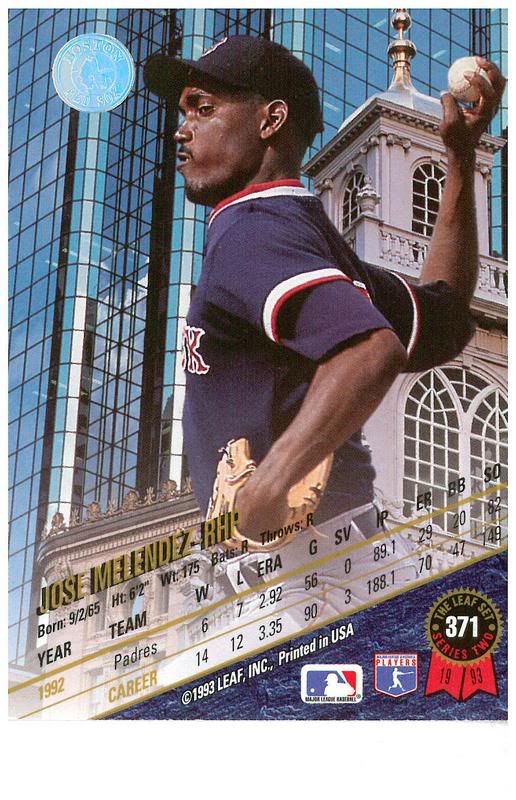
It’s time for Jose Melendez’s KEY TO THE GAME.
As fall begins to easy into frigid winter, Jose ought to take a break from his busy schedule of sitting on the stoop and watching the world go buy to give thanks to the San Francisco Giants.
“But why, thank the Giants?” you may be asking. “You’re not a fan, supporter or even a well-wisher Jose.”
True enough. Nevertheless, Jose owes the Giants a heartfelt thanks, a big hug that includes backrubbing that goes on long enough that it gets a bit awkward. For you see, the Giants have reminded Jose of the greatest lesson of all—that God loves us.
Wait, that doesn’t sound like Jose.
Ah, here it is, the Giants have reminded Jose of the greatest lesson of all—the lesson of 2004.
Yeah, that’s the ticket.
You’d think the lesson of 2004 would have stuck with Jose this long, that such a profound and valuable educational experience would have lasted far more than the six years it took to escape from Jose’s mind like so many facts about the periodic table of elements. And yet there, it went. All off to naught.
Some of you may be in the same predicament as Jose, struggling to remember exactly what was the lesson of that magical October. There are so many profound insights, that it is hard to remember what was the overriding lesson. Was it not to let us win tonight? Was it not to slap the ball out of a first baseman’s mitt? Or was it to never use Javier Vasquez in a seventh game? These are all good lessons, but none of them is THE lesson.
The lesson of 2004 is that the only way to break the cold chains of history is with focused will and brutal force. The Red Sox did it in 2004, and the Giants did it again in 2010. History repeats itself the first time as comedy, the second time also as comedy.
When the Red Sox won in 2004, Dan Shaughnessy, among others, suggested that at long last Lucy had let Charlie Brown kick the football, that finally, instead of yanking the football away and leaving old Chuck angry, distrustful and flat on his back, the bitch in the blue dress had left her finger on the ball, and let Charlie kick it swift and strong.
It’s a nice metaphor is some ways. The idea of the cycle being broken is appealing. Bruce Banner has stopped becoming the Hulk forever. Gilligan gets off the island. The sins of the father are not visited upon the son. But that’s not what happened.
Lucy did not let Charlie Brown kick the football. She wouldn’t. She can’t. Such an act of kindness would render her utterly un-Lucy. History is not made when the villains suddenly discover their kinder side.
No, what the Red Sox did it 2004 was seize their destiny by force. Charlie Brown ran to kick the football, and when Lucy yanked it back, instead of following through to the predictable, tragic confusion, Charlie floored her with a roundhouse kick. Then Charlie picked up the ball, as Lucy lay stunned, and drop kicked it through the uprights straight and true. 2004 was an act of defiance, not a concession.
The Giants in 2010 were a bit different. There was no clear Lucy, no Yankees to knock to the turf. But there is always a nemesis, whether tangible or implicit, and the Giants conquered theirs.
The lesson, to Jose, to all of us, is not to be a passive player in history, to allow one’s fate to be written by the Lucys of this world. Rather, we must realize that we have agency. The future is not written. The die is not cast.
Like the Red Sox, like the Giants, we can break the cycle if only we have the will, the strength and the flexibility to deliver that roundhouse kick.
I’m Jose Melendez, and that is my KEY TO THE GAME.
Saturday, November 20

Saturday, November 13
What Jose Is
It’s time for Jose Melendez’s KEY TO THE GAME.
Some months ago Jose started a new job, a job he shall henceforth refer to as…
Wait…
No…
He’s never going to refer to it.
Never.
Anyway, Jose was at an event in his new home city of Washington, DC where there was an icebreaker. You know, it was one of those events where either a) boring people offer the one interesting detail in their pathetic little lives or b) interesting people try to one up each other. In this case the instruction was “Tell us something interesting about yourself that we don’t already know.”
Jose had precious few options, either he could reveal he was a Red Sox blogger, declare that he once did pushups and sit ups every day for four years without a single missed day, or he could talk about that time with the Olympic swimmer on top of Mt. Washington, and that’s neither appropriate nor true. So, Jose being Jose, he went with the blogging.
“Jose is a Red Sox blogger,” Jose pointed out. “His blog was named Boston’s best by the Boston Phoenix in 2005.”
And then the baton passed to the guy who went to Space Camp, to the woman who wrote the score to The King and I, and so on. But Jose felt no relief. Taking his turn had not proven to be the Alka Seltzer of self-revelation to the burning indigestion of his anxiety at revealing something interesting. No the anxiety had only increased as acid and base combined to a bubbling froth. But Jose had revealed something about himself, hadn’t he?
Yes.
He had revealed that he is a liar.
Where does Jose get off saying that he is a Red Sox blogger?
Jose could say he WAS a Red Sox blogger. That would be true. But IS? Jose hasn’t blogged seriously about the Red Sox since 2007. Sure he’s written the occasional piece, but he’s written far more about Africa in the last three years than he has about baseball, and he doesn’t even do that much anymore.
Jose doesn’t want to think of himself as a liar. It’s not a nice thing to be. A liar is someone like Rick Pitino, which would implies that lying is only a step or two away from having 35 seconds of sex with a woman at a seedy Louisville restaurant after closing time, and while calling Pitino “Quick Rick” is hysterical, Jose has no interest in being called “No Foreplay Jose.” Thus, Jose got quickly down to the business of self-delusion and rationalization, which, as Jose has pointed out before, are the Shinotism and Buddhism to his Japan. He would also point out that they are Objectivism and Aqua Buddhism to Jose’s Rand Paul.
So let’s wade into Jose’s case that he is a Red Sox blogger. First, Red Sox blogging is not something one does, it’s something one is. For example, if someone asked Jason Varitek if he is a major league catcher, he would answer yes, even though he clearly hasn’t done the work of a major league catcher for years. It doesn’t matter—it’s just part of his being. By contrast, if you asked Alex Rodriguez if he is a Yankee, if he were being honest, he’d have to answer no, because, as we all know, Yankees are not centaurs—they are more like pigdogs.
Second… Actually, that’s all Jose’s got.
But it’s something he can work with. For four years Jose wrote on damn near every game occurring on a weekday and not when he was tired, bored, antsy or otherwise uninterested in writing. That makes him something—a basement dwelling dork with way too much time on his hands. But it also makes him a Red Sox blogger, and nothing can take that away, not even never writing about the Red Sox, living far away from Boston, and having no idea prior to their Red Sox debut who Daniel Nava or Darnell McDonald were prior to their Red Sox debuts.
Now Jose is not going to make some Bill Simmons style declaration that he is back. Jose is categorically not back. 2004 is not walking through that door; 2005 is not walking through that door 2007 is not walking through that door. (Note: Jose is not even going to talk about 2006. Never.) And if they do… well, it would be awesome. But it’s not going to happen so who cares?
All Jose is going to say is that he needs this and he will try to do this from time to time. It’s who he is and he refuses to change. Jose needs a place where he can write flabby prose, where he can occasionally use the passive voice, and yes, where he can make completely unsupported statements without fear of consequence, and Jose thinks that maybe, just a little bit, you need it too.
I’m Jose Melendez, and that is my KEY TO THE GAME.
Some months ago Jose started a new job, a job he shall henceforth refer to as…
Wait…
No…
He’s never going to refer to it.
Never.
Anyway, Jose was at an event in his new home city of Washington, DC where there was an icebreaker. You know, it was one of those events where either a) boring people offer the one interesting detail in their pathetic little lives or b) interesting people try to one up each other. In this case the instruction was “Tell us something interesting about yourself that we don’t already know.”
Jose had precious few options, either he could reveal he was a Red Sox blogger, declare that he once did pushups and sit ups every day for four years without a single missed day, or he could talk about that time with the Olympic swimmer on top of Mt. Washington, and that’s neither appropriate nor true. So, Jose being Jose, he went with the blogging.
“Jose is a Red Sox blogger,” Jose pointed out. “His blog was named Boston’s best by the Boston Phoenix in 2005.”
And then the baton passed to the guy who went to Space Camp, to the woman who wrote the score to The King and I, and so on. But Jose felt no relief. Taking his turn had not proven to be the Alka Seltzer of self-revelation to the burning indigestion of his anxiety at revealing something interesting. No the anxiety had only increased as acid and base combined to a bubbling froth. But Jose had revealed something about himself, hadn’t he?
Yes.
He had revealed that he is a liar.
Where does Jose get off saying that he is a Red Sox blogger?
Jose could say he WAS a Red Sox blogger. That would be true. But IS? Jose hasn’t blogged seriously about the Red Sox since 2007. Sure he’s written the occasional piece, but he’s written far more about Africa in the last three years than he has about baseball, and he doesn’t even do that much anymore.
Jose doesn’t want to think of himself as a liar. It’s not a nice thing to be. A liar is someone like Rick Pitino, which would implies that lying is only a step or two away from having 35 seconds of sex with a woman at a seedy Louisville restaurant after closing time, and while calling Pitino “Quick Rick” is hysterical, Jose has no interest in being called “No Foreplay Jose.” Thus, Jose got quickly down to the business of self-delusion and rationalization, which, as Jose has pointed out before, are the Shinotism and Buddhism to his Japan. He would also point out that they are Objectivism and Aqua Buddhism to Jose’s Rand Paul.
So let’s wade into Jose’s case that he is a Red Sox blogger. First, Red Sox blogging is not something one does, it’s something one is. For example, if someone asked Jason Varitek if he is a major league catcher, he would answer yes, even though he clearly hasn’t done the work of a major league catcher for years. It doesn’t matter—it’s just part of his being. By contrast, if you asked Alex Rodriguez if he is a Yankee, if he were being honest, he’d have to answer no, because, as we all know, Yankees are not centaurs—they are more like pigdogs.
Second… Actually, that’s all Jose’s got.
But it’s something he can work with. For four years Jose wrote on damn near every game occurring on a weekday and not when he was tired, bored, antsy or otherwise uninterested in writing. That makes him something—a basement dwelling dork with way too much time on his hands. But it also makes him a Red Sox blogger, and nothing can take that away, not even never writing about the Red Sox, living far away from Boston, and having no idea prior to their Red Sox debut who Daniel Nava or Darnell McDonald were prior to their Red Sox debuts.
Now Jose is not going to make some Bill Simmons style declaration that he is back. Jose is categorically not back. 2004 is not walking through that door; 2005 is not walking through that door 2007 is not walking through that door. (Note: Jose is not even going to talk about 2006. Never.) And if they do… well, it would be awesome. But it’s not going to happen so who cares?
All Jose is going to say is that he needs this and he will try to do this from time to time. It’s who he is and he refuses to change. Jose needs a place where he can write flabby prose, where he can occasionally use the passive voice, and yes, where he can make completely unsupported statements without fear of consequence, and Jose thinks that maybe, just a little bit, you need it too.
I’m Jose Melendez, and that is my KEY TO THE GAME.
Thursday, July 15
In Kristof Too Popular to Be a Good Reporter?
My friend and fellow BU alumnus Jina Moore, who unlike me, is an actual Africa reporter rather than a dilettante who writes on Africa with an almost excruciating self awareness wrote a thoughtful piece in response to the recent exchange between the New York Times’ Nicholas Kristof and Africa blogger texasinafrica.
For those of you who come to this space for my infrequent baseball posts rather than commentary on Africa, here’s the background.
Texasinafrica submitted the following question to Kristof “Your columns about Africa almost always feature black Africans as victims, and white foreigners as their saviors.” Yes, that is a statement and not a question, but forgive me, it’s a paraphrase of Texasinafrica’s paraphrase of the original question.
Kristof, to his credit, took the questions and the nut of his answer, as transcribed by NYTpick was
The problem that I face -- my challenge as a writer -- in trying to get readers to care about something like Eastern Congo, is that frankly, the moment a reader sees that I'm writing about Central Africa, for an awful lot of them, that's the moment to turn the page. It's very hard to get people to care about distant crises like that.
One way of getting people to read at least a few grafs in is to have some kind of a foreign protagonist, some American who they can identify with as a bridge character.
And so if this is a way I can get people to care about foreign countries, to read about them, ideally, to get a little bit more involved, then I plead guilty.It’s also clear to any journalist that it’s very difficult to engage readers and viewers in distant crises. That’s why television has pretty much stopped covering public health and global poverty. Some years ago, Anderson Cooper went out to eastern Congo to report on the crisis there. It was expensive and risky for CNN — and his ratings for those shows fell. The lesson for any television executive producer is not to cover such crises, but to throw a Democrat and a Republican in a room together and have them yell at each other. It will be less expensive, more entertaining and will get ratings up.
Caught up? Good.
It’s at this point in our story that Moore comes in with a 2X4, albeit a thoughtful 2X4, and proceeds to beat Kristof about the head with it. That 2X4 is the implication that Kristof’s primary interest is either getting Americans to read his columns or, more generously, getting Americans to act in support of poverty alleviation and conflict reduction rather than reporting “The Truth” about various places and people in Africa.
Moore articulates three specific criticisms of Kristof’s response. First, she attacks his focus on eyeballs arguing that doing solid reporting on a place like DRC, even if few people read, watch or hear it is “a kind of journalistic corporate social responsibility.” In other words, she argues that good Africa reporting is the moral price a media outlet must pay for throwing talking heads into a room to scream talking points at each other the rest of the time.
While Moore does add that “we used to just call it journalism, but times have changed,” this old PR flack couldn’t help but be horrified at the invocation of corporate social responsibility. Corporate social responsibility is slight of hand. It is the conjurer drawing your eye to his waving left hand while palming a coin with his right. In the context of journalism, it evokes newspapers that run “serious” stories about Africa so they don’t have to write valuable stories about Africa. History does not require American reporters to scribble the first draft of African history. African journalists can and do perform that function far better than any American. What the American journalist can do that his African partners often cannot is get some elements of this newly minted history into the homes of other Americans. Kristof does this with a success that is unequaled among American journalists.
Moore’s second critique is to challenge Kristof’s assertion that he engages more Americans in African issues by focusing on white interlopers. He has no idea how engaged his readers are, Moore points out, a truism if ever there was one. Measuring eyeballs, clicks or impressions is easy, measuring psychological impact is hard and measuring how an impact translates into action is harder still. But the fact that her statement about engagement is true does not mean that it is useful.
I like action. I think driving action is the point of reporting on ignored tragedies. Expanding the universe of knowledge is the realm of academics. The role of reporters is to diffuse knowledge, to give people the accurate information required to undertake (or decline to undertake) action in the world. For those who want facts analyzed with academic rigor there are the journals. For those who want constant updates or detailed narrative there are books and blogs. For people who are prepared to take action, there are endless resources to enable them. They will not be relying on Nicholas Kristof to tell them what Africa is “really like.” The Americans who care a lot about Africa have arrived there through different paths based on personal experience, academic interest or perhaps even plain circumstance. Surely none of them came to their deep commitment through reading Kristof columns. Rather, Kristof’s power is to get good people who don’t care at all about Africa to care a little, and in a nation of 300 million, that is a valuable service. (Though perhaps this is self-defeating. If Kristof got more Americans highly interested in Africa, wouldn’t it give him more American saviors to write about?)
Finally, Moore argues that the measure of a journalist should not be the number of eyeballs he draws to the word, but the “kinds of stories we see and whether they reflect the place that some of us have dedicated not only our professional but our personal lives to getting to know.” Her subtext appears to be that Kristof is a bit of a dilettante, that he has not spent both his professional and personal life getting to know Africa and that this constraint is reflected in his work. But it is far from certain that experience leads to accuracy. After all, Henry Morton Stanley was more deeply immersed in Africa than perhaps any white man of his generation (and most since), and yet he consistently produced fabulism. Of course, it does not necessarily follow from the fact that lifers can write schlock that short timers can write Truth. But the logic does not exclude the possibility either. For example, Tocquville spent less than two years in the U.S. before writing Democracy in America, which makes less of a dilettante than I, but more than the average Peace Corps volunteer
This rebuttal is not intended as a defense of Kristof’s reporting. Its value and its flaws are evident and widely discussed. Rather it is intended as a defense of his intentions. While it is reasonable to question whether Kristof’s writing overemphasizes the importance of foreigners in fighting Africa’s problems, it is unreasonable to condemn him for attempting to make his stories more accessible to the average American. The record of American media on Africa is poor. They bought into a false narrative that the Rwandan Genocide was caused by state failure. They perpetuated the myth that drought, rather than war/politics was the cause of the Ethiopian famine. They told us next to nothing, right or wrong, about the Congo War. Against this track record, I will gladly settle for accurately reported, widely read columns about Africa in a major newspaper regardless of whether they too often regard the white man as the white knight.
Tuesday, July 13
The Man is Dead--Long Live the Joke
It’s time for Jose Melendez’s KEYS TO THE ALL-STAR GAME.
1. Jose is not sorry that George Steinbrenner is dead.
Of course, he’s not happy either.
For the most part, Jose feels what he does whenever any moderately below average human being whom he does not know personally dies—not much.
Sure it would be fun to rant and rave about how loathsome Jose finds the departed, how he was bad for baseball, a convicted felon and even, Jose has heard, a lousy shipbuilder. But that would give the man too much credit.
Instead, Jose prefers to reflect on the comments of an African man in a class for which Jose is a teaching assistant. As Jose mentioned to a friend that George Steinbrenner had died, the African interjected “He was a real guy? I only knew him from Seinfeld.”
To Jose that captures Steinbrenner perfectly. When one takes the measure of the man, sums up a lifetime of debits and credits, the sum, in this case doesn’t matter. The essence of Steinbrenner was neither philanthropist nor felon, industrialist nor instigator. He was a joke. He was a punch line ranting about eating a soup in a bread bowl for lunch every day on Seinfeld. He was the word David Letterman put before “sucks” to get a cheap laugh in the days before Joey Buttafuoco. He was someone who could be played by the tremendously unserious Oliver Platt.
Yes, Steinbrenner was bad for baseball. Yes, he did give a lot of money to the Jimmy Fund. But no, he is not deserving of much celebration or scorn as he returns to the dust. He was just a man, and today he is just a man who died. But the joke, the joke lives on.
I’m Jose Melendez, and that is my KEY TO THE ALL-STAR GAME.
Wednesday, June 30
Shadow Pricing
It’s time for Jose Melendez’ KEY TO THE GAME.
For the next month, Jose is working as a teaching assistant in a class designed to teach international development officials how to do cost-benefit analysis (CBA). The idea behind CBA is that in analyzing a project, one should calculate the total benefit and costs derived from the project over time, and then use a discount rate to account for the time value of money, how one values 10 dollars in a year versus 10 dollars today.
At first it seems quite simple, like all one has to do is project the revenues and expenditures calculate the net present value and rejoice.
But it’s not that easy. In order to do an economic analysis, not just a financial analysis, one must calculate all of the costs and benefits, not just those that are obvious. For example, in the case of a project that causes some pollution, one has to include the cost of pollution in the equation. One must also include the opportunity cost of the project. What is not getting done because this project is going forward? As Professor Robert Conrad put it, “Never let anyone tell you that sitting on a milk crate on your front porch drinking a Pabst Blue Ribbon beer, is not a socially productive activity.”
This endeavor has made Jose wonder if we are really valuing our baseball players correctly. Sure, the Sabermetrics crowd has developed lots of new statistics that measure what players are doing, but is that enough? What about what players aren’t doing? There are some statistics that have captured assess some of the things players don’t do, such as making outs, but Jose knows that isn’t enough.
For example, with Jacoby Ellsbury replaced by Daniel Nava, we know what we’re missing in terms of actions—we’re losing so many hits, so many stolen bases and so on, but what are the inactions we’re missing? What is the added value of the time in front of the mirror that is opened up because Ellsbury isn’t standing in front of it working on his puppy dog eyes?
We know that with Josh Beckett’s injury we have lost so many strikeouts, innings pitched and so on, but we have also gained valuable hours of our lives that are no longer being squandered watching Beckett wait 20 seconds between each pitch. From the perspective of the total economy, it is possible that Josh Beckett’s injury is a net positive.
CBA can be at its most useful in measuring projects where benefits are relatively clear, such as the construction of a bridge. Thus, Jose hopes that it might be useful in assessing what Jose regards as the Red Sox’s most urgent project need, constructing a bridge to the closer.
Given that Jonathan Papelbon is under contract for two years, Jose regards this as a two-year project. That is not enough. If we have to expend $X in talent and salaries this year and next to build and sustain the bridge, then we must derive enough benefit from that bridge this year and next year (note: at a discount rate of let’s say. 03 because that is the standard in health projects, and health is clearly the biggest issue here) if the project is worth doing. Jose doesn’t see this having a positive net present value. We’re going to have to invest a lot up front to get a benefit that will last a maximum of two years, and even that is speculative. Since the bridge is built to a shaky terminus (note: Papelbon) it seems completely possible that we may not even be able to enjoy the full life of the project. Therefore, if the Red Sox are to invest in a project, investing in the terminus, a closer, seems to be a wiser choice than investing in a bridge to the closer. And that’s if one doesn’t calculate a shadow price that accounts for externalities like pollution. If one includes the noise pollution from the nonsense coming out of Papelbon’s mouth, there’s absolutely no doubt that this bridge project is a dog.
I’m Jose Melendez, and that is my KEY TO THE GAME.
Tuesday, June 29
Tha Spanish Flu
It’s time for Jose Melendez’s KEYS TO THE GAME.
1. With Victor Martinez joining Dustin Pedroia, Jacoby Ellsbury, St. Josh Beckett, Jeremy Hermida, Mike Cameron, DJ Dru, Daisuke Matsuzaka and others among the sick and wounded, more and more people are suggesting that an epidemic comparable to the Black Plague has broken out in the Red Sox clubhouse. Jose thinks that this analogy is false, or worse, inapt. The Black Death wiped out about a third of the population of Europe and Jose is fairly confident that this particular epidemic will ultimately strike well over a third of the Red Sox clubhouse.
Jose suspects that the better analogy is the Spanish flu of 1918. There are three reasons that Jose draws this analogy. First, since a significant chunk of the injuries are caused by Hispanophone third baseman Adrian Beltre, comparing it to a Spanish germ seems appropriate. Second, in 1918, the Red Sox won the World Series, as they will this year. Finally, as Jose has sadly learned from associating with women in their 30s who are a little too in to abstinent vampires, the Spanish Flu marks the origin of America’s sexiest vampire. This current Red Sox epidemic has given us Daniel Nava who is definitely sexy and, thanks to his fixation on the unattainable Erin Andrews, possibly abstinent. Moreover, while Nava is not over 100 years old, he is, like the high school vampire, far too old to be doing what he’s doing. On the other hand, it is not at all clear that he is a vampire, as thus far he has shown no evidence of sucking.
2. Jose is really tired of economics, of the dismal science of dollars and cents, ruining sports. Jose tried to forgive Manny Ramirez. He really did. Actually, he succeeded. Jose wasn’t there for Manny’s return, but had he been, he would have stood and cheered until a mild fatigue set in and he decided to sit down and/or get another beer.
But no more.
Jose learned last night while watching ESPN News that Takeru Kobayashi has opted out of this year’s Nathan’s Famous Hot Dog eating contest due to a stall in contract negotiations. Do you remember where you were when you lost your innocence? Jose does. The Federal on Main Street in Durham, NC sucking down an Iron City Beer. It was one thing when money ruined baseball, basketball, football, hockey, billiards, bowling and scrabble. But competitive eating? It’s supposed to be about the love, man.

Kobayashi being Manny?
3. Whenever Jose’s brother Sam sees Darnell McDonald, he thinks about Darnell from My Name is Earl, aka the Crab Man. Ergo, Jose wants to call McDonald “the Crab Man.” This is not to be confused with the promiscuous Wade Boggs who was, of course, known as “The Crabs Man.”
I’m Jose Melendez, and those are my KEYS TO THE GAME.
1. With Victor Martinez joining Dustin Pedroia, Jacoby Ellsbury, St. Josh Beckett, Jeremy Hermida, Mike Cameron, DJ Dru, Daisuke Matsuzaka and others among the sick and wounded, more and more people are suggesting that an epidemic comparable to the Black Plague has broken out in the Red Sox clubhouse. Jose thinks that this analogy is false, or worse, inapt. The Black Death wiped out about a third of the population of Europe and Jose is fairly confident that this particular epidemic will ultimately strike well over a third of the Red Sox clubhouse.
Jose suspects that the better analogy is the Spanish flu of 1918. There are three reasons that Jose draws this analogy. First, since a significant chunk of the injuries are caused by Hispanophone third baseman Adrian Beltre, comparing it to a Spanish germ seems appropriate. Second, in 1918, the Red Sox won the World Series, as they will this year. Finally, as Jose has sadly learned from associating with women in their 30s who are a little too in to abstinent vampires, the Spanish Flu marks the origin of America’s sexiest vampire. This current Red Sox epidemic has given us Daniel Nava who is definitely sexy and, thanks to his fixation on the unattainable Erin Andrews, possibly abstinent. Moreover, while Nava is not over 100 years old, he is, like the high school vampire, far too old to be doing what he’s doing. On the other hand, it is not at all clear that he is a vampire, as thus far he has shown no evidence of sucking.
2. Jose is really tired of economics, of the dismal science of dollars and cents, ruining sports. Jose tried to forgive Manny Ramirez. He really did. Actually, he succeeded. Jose wasn’t there for Manny’s return, but had he been, he would have stood and cheered until a mild fatigue set in and he decided to sit down and/or get another beer.
But no more.
Jose learned last night while watching ESPN News that Takeru Kobayashi has opted out of this year’s Nathan’s Famous Hot Dog eating contest due to a stall in contract negotiations. Do you remember where you were when you lost your innocence? Jose does. The Federal on Main Street in Durham, NC sucking down an Iron City Beer. It was one thing when money ruined baseball, basketball, football, hockey, billiards, bowling and scrabble. But competitive eating? It’s supposed to be about the love, man.

Kobayashi being Manny?
3. Whenever Jose’s brother Sam sees Darnell McDonald, he thinks about Darnell from My Name is Earl, aka the Crab Man. Ergo, Jose wants to call McDonald “the Crab Man.” This is not to be confused with the promiscuous Wade Boggs who was, of course, known as “The Crabs Man.”
I’m Jose Melendez, and those are my KEYS TO THE GAME.
Thursday, June 17
WIth a Tangled Skein
It’s time for Jose Melendez’s KEYS TO GAME 7.
1. It is typically the purview of prophets and sages to unwind the tangled skein of destiny (note: for metaphor see Piers Anthony) and see where each thread leads. But there are times, there are moments in the endless chain of history, where mere mortals can find an unknotted thread, where mere men can rise in the morning and perceive their thread extending into the distance. Today is one of those days.
Today, men clad in green and white have risen from their beds with the knowledge, with the certainty, that the events that transpire today will be a turning point in their lives. When next close their eyes, they will be Perseus, forever immortalized in the stars themselves, or they will be Sisyphus, endlessly reaching for a glory just out of reach. Those are the only options: death or glory, mice or men, pride or prejudice, sense or sensibility, paper or plastic, T or A, rock or roll, strut or stroll, Hall or Oates, Sanford or Son. This is not a dialectic. There is a thesis and an antithesis, but there ain’t gonna be no synthesis.
Let’s put it this way. When an irresistible force meets and immovable object, F- the Lakers.
2. It should come as no surprise that the key to Game 7 is going to be rebounding. The team that has won the battle on the boards has claimed each of the first six games in the series and tonight should be no different. However, with Red Sox draftee/Celtics center Kendrick Perkins out and Lakers center Andrew Bynum hobbled, it is increasingly difficult to project which team will collect the most rebounds.
Jose’s analysis suggests that the edge lies with the Celtics. Paul Pierce rebounded from 11 stab wounds to return to NBA dominance. Kevin Garnett rebounded from a career trapped in the basketball purgatory of the twin cities to win an NBA championship. Tony Allen rebounded from near terminal stupidity to become a defensive force. Rajon Rondo rebounded from not being 100% sure how his own name is pronounced. Ray Allen, played a character named Jesus, which Jose is pretty sure means he can rebound from his own death. Big Baby Davis rebounded from a brutal time growing up and, if the latest Shrek movie can be believed, a reality in which he was never even born. Nate Robinson rebounded from playing with the New York Knicks. And last but not least, Rasheed Wallace, based on his personal grooming, rebounded from a period of homelessness.
The Lakers by contrast have Kobe Bryant, who rebounded from being accused of a horrible crime. Ron Artest, who rebounded… kind of… from one of the NBA’s most celebrated psychotic breaks, and Pau Gasol, who even now must rebound from watching his beloved Spanish floppers fall 1-0 in World Cup competition to the Swiss, a country that is literally based on the idea of having no offense.
Edge: Celtics.
3. Jose does not like sports the way he used to. Sure he still enjoys going to the games, he gets a kick out of watching his teams on television, and sports continues to play a major role in his life. Still, it’s not the same as it used to be. Jose has seen damn near everything he wanted to see in sports at a time in his life when he could a) experience it while drinking beer and b) could go out on the town to celebrate without asking for permission, and that takes the edge off of being a sports fan.
The existential angst is gone too. Without the fear of “never seeing them win it all,” the terror is gone. But when the terror departs, so does the joy at having overcome terror. In 2002, Jose would have spent all winter ruminating about Paplebon’s Game 3 collapse. This year he spent a day, maybe two. The games, all games, simply don’t mean as much as they used to.
But that changes tonight. Tonight, for the first time since at least the Patriots’ last Super Bowl, Jose feels the terror. Tonight, the game means every bit as much as it used to. If the Celtics lose, Jose fully expects to wake up tomorrow with that old familiar pain, as if someone had died and the world is now a darker, more sinister place. If the Celtics win, Jose expects to rise in the morning committed to the absurd proposition that the world is a better place thanks to a basketball game.
Jose knows why too. This is not only about the Celtics winning; it is about the Lakers losing. Jose hates the Lakers. They, like the Yankees, fill the yearning for nationalist hatred that Jose’s liberalism and compassion prevent him from expressing in his politics. They are the other, the barbarians. If one follows Clausewitz’s famous axiom and “War is politics by other means” then surely basketball is war by other means, in the sense that it is an effort to impose one’s will on the other through sheer physical and psychological domination.
Jose is not so trite as to suggest that, in this time of real war, that basketball is anything more than metaphor for war. All he is saying is that he wants to burn Los Angeles to the ground, and sow their fields with salt.
I’m Jose Melendez, and those are my KEYS TO GAME 7.
1. It is typically the purview of prophets and sages to unwind the tangled skein of destiny (note: for metaphor see Piers Anthony) and see where each thread leads. But there are times, there are moments in the endless chain of history, where mere mortals can find an unknotted thread, where mere men can rise in the morning and perceive their thread extending into the distance. Today is one of those days.
Today, men clad in green and white have risen from their beds with the knowledge, with the certainty, that the events that transpire today will be a turning point in their lives. When next close their eyes, they will be Perseus, forever immortalized in the stars themselves, or they will be Sisyphus, endlessly reaching for a glory just out of reach. Those are the only options: death or glory, mice or men, pride or prejudice, sense or sensibility, paper or plastic, T or A, rock or roll, strut or stroll, Hall or Oates, Sanford or Son. This is not a dialectic. There is a thesis and an antithesis, but there ain’t gonna be no synthesis.
Let’s put it this way. When an irresistible force meets and immovable object, F- the Lakers.
2. It should come as no surprise that the key to Game 7 is going to be rebounding. The team that has won the battle on the boards has claimed each of the first six games in the series and tonight should be no different. However, with Red Sox draftee/Celtics center Kendrick Perkins out and Lakers center Andrew Bynum hobbled, it is increasingly difficult to project which team will collect the most rebounds.
Jose’s analysis suggests that the edge lies with the Celtics. Paul Pierce rebounded from 11 stab wounds to return to NBA dominance. Kevin Garnett rebounded from a career trapped in the basketball purgatory of the twin cities to win an NBA championship. Tony Allen rebounded from near terminal stupidity to become a defensive force. Rajon Rondo rebounded from not being 100% sure how his own name is pronounced. Ray Allen, played a character named Jesus, which Jose is pretty sure means he can rebound from his own death. Big Baby Davis rebounded from a brutal time growing up and, if the latest Shrek movie can be believed, a reality in which he was never even born. Nate Robinson rebounded from playing with the New York Knicks. And last but not least, Rasheed Wallace, based on his personal grooming, rebounded from a period of homelessness.
The Lakers by contrast have Kobe Bryant, who rebounded from being accused of a horrible crime. Ron Artest, who rebounded… kind of… from one of the NBA’s most celebrated psychotic breaks, and Pau Gasol, who even now must rebound from watching his beloved Spanish floppers fall 1-0 in World Cup competition to the Swiss, a country that is literally based on the idea of having no offense.
Edge: Celtics.
3. Jose does not like sports the way he used to. Sure he still enjoys going to the games, he gets a kick out of watching his teams on television, and sports continues to play a major role in his life. Still, it’s not the same as it used to be. Jose has seen damn near everything he wanted to see in sports at a time in his life when he could a) experience it while drinking beer and b) could go out on the town to celebrate without asking for permission, and that takes the edge off of being a sports fan.
The existential angst is gone too. Without the fear of “never seeing them win it all,” the terror is gone. But when the terror departs, so does the joy at having overcome terror. In 2002, Jose would have spent all winter ruminating about Paplebon’s Game 3 collapse. This year he spent a day, maybe two. The games, all games, simply don’t mean as much as they used to.
But that changes tonight. Tonight, for the first time since at least the Patriots’ last Super Bowl, Jose feels the terror. Tonight, the game means every bit as much as it used to. If the Celtics lose, Jose fully expects to wake up tomorrow with that old familiar pain, as if someone had died and the world is now a darker, more sinister place. If the Celtics win, Jose expects to rise in the morning committed to the absurd proposition that the world is a better place thanks to a basketball game.
Jose knows why too. This is not only about the Celtics winning; it is about the Lakers losing. Jose hates the Lakers. They, like the Yankees, fill the yearning for nationalist hatred that Jose’s liberalism and compassion prevent him from expressing in his politics. They are the other, the barbarians. If one follows Clausewitz’s famous axiom and “War is politics by other means” then surely basketball is war by other means, in the sense that it is an effort to impose one’s will on the other through sheer physical and psychological domination.
Jose is not so trite as to suggest that, in this time of real war, that basketball is anything more than metaphor for war. All he is saying is that he wants to burn Los Angeles to the ground, and sow their fields with salt.
I’m Jose Melendez, and those are my KEYS TO GAME 7.
Monday, May 3
Whatever Happens They Have Got.
It’s time for Jose Melendez’s KEYS TO THE GAME.
Jose is a little bored.
He’s done with school, hasn’t started with work and his car has a problem stopping which makes going on a long pointless drive to some place like Metropolis, Kentucky a less than great idea. He raised the issue of his ennui with Granny Melendez the other day, and she suggested that he take up a hobby. Jose wanted to respond that baseball is his hobby, but a hobby is supposed to bring some level of enjoyment and make the time pass more quickly, so baseball isn’t much of a hobby these days—it’s more of a burden really. So she suggested, that Jose go to Michael’s and take up some sort of crafts hobby.
This doesn’t seem terribly likely. First, Jose is not that crafty. He’s not Jamie Moyer. Second what exactly would Jose do? Could he make images of DJ Dru out of macaroni? Perhaps he could needlepoint inspirational messages like “Catch the bleeping ball.” Maybe he could make a scrapbook commemorating Adrian Beltre’s walks? Of course, that one isn’t going to kill much time.
Ultimately, it just doesn’t feel like the right kind of hobby for Jose. Still, Jose needed some kind of distraction, so he thought he’d return to the sort of thing he enjoyed back before his days as a scholar. Jose picked up some history books and began scanning them for historical events that he could compare inappropriately to the Red Sox. Given the current state of the club, he went directly to the tragic, and lo and behold, he found it, and fast.
Trust Jose, there is no better place to find analogies to the current state of the Red Sox than in the colonial history of Tanganyika. Immediately, the similarities were clear. Pre-colonial Tanganyika lacked broad central organization, so do the Red Sox. Colonial Tanganyikans had no idea how to play baseball, neither do the Red Sox. But the specific analogy Jose would like to draw is between the Maji Maji Rebellion and the 2010 Red Sox.
For those of you who are victims of our public schools’ tragic under-emphasis of early 20th Century East African history, the Maji Maji Rebellion was a revolt of various Tanganyikan tribes against German rule that lasted from 1905 to 1907. The maji, for which the rebellion is named, was a tribal medicine that, many believed, would turn German bullets to water. Armed with the confidence that they were impervious to the Germans’ terrifying machine guns, warriors treated with maji put up the last great resistance of the German colonial era. The problem, of course, was that the maji didn’t work. By one estimate, the final tally was 250,000-300,000 rebels dead compared with 15 Europeans, 73 askari (locals fighting for the Germans) and 316 auxiliaries (note: from John Illife’s excellent, if dense, A History of Modern Tanganyika p.200).
As miserably inappropriate as it is to compare slaughter on this scale to something as trivial as baseball, (note: not trivial), there is an analogy to be drawn.
The leaders of the Maji Maji Rebellion repeated often and loudly that the maji would work. The repeated it so often that many people, though far from all, began to believe it, despite all evidence. The Red Sox did the same thing. All summer, they told us about a charm called run prevention and how it would neutralize the maxim guns running up and down the Yankees and Rays lineups. And armed with this confidence in the magic, we the soldiers of Red Sox nation charged into the breech, and guess what? Yeah. Our stats look only marginally better than the Maji Maji.
Hillaire Beloc once wrote in his poem The Modern Traveler.
Jose would suggest that when the line and verse is written for this season the most memorable line will be:
Perhaps, we don’t really need an offensive team. Perhaps if the pitchers had thrown as advertised and the fielders had picked the horsehide clean and crisp, the offensive struggles would not have been a problem. Of course, if the maji had worked, the rebels’ lack of machine guns wouldn’t have been a problem either. And so we are stuck outgunned relying on magicks both ancient and really ineffective.
I’m Jose Melendez, and those are my KEYS TO THE GAME.
Jose is a little bored.
He’s done with school, hasn’t started with work and his car has a problem stopping which makes going on a long pointless drive to some place like Metropolis, Kentucky a less than great idea. He raised the issue of his ennui with Granny Melendez the other day, and she suggested that he take up a hobby. Jose wanted to respond that baseball is his hobby, but a hobby is supposed to bring some level of enjoyment and make the time pass more quickly, so baseball isn’t much of a hobby these days—it’s more of a burden really. So she suggested, that Jose go to Michael’s and take up some sort of crafts hobby.
This doesn’t seem terribly likely. First, Jose is not that crafty. He’s not Jamie Moyer. Second what exactly would Jose do? Could he make images of DJ Dru out of macaroni? Perhaps he could needlepoint inspirational messages like “Catch the bleeping ball.” Maybe he could make a scrapbook commemorating Adrian Beltre’s walks? Of course, that one isn’t going to kill much time.
Ultimately, it just doesn’t feel like the right kind of hobby for Jose. Still, Jose needed some kind of distraction, so he thought he’d return to the sort of thing he enjoyed back before his days as a scholar. Jose picked up some history books and began scanning them for historical events that he could compare inappropriately to the Red Sox. Given the current state of the club, he went directly to the tragic, and lo and behold, he found it, and fast.
Trust Jose, there is no better place to find analogies to the current state of the Red Sox than in the colonial history of Tanganyika. Immediately, the similarities were clear. Pre-colonial Tanganyika lacked broad central organization, so do the Red Sox. Colonial Tanganyikans had no idea how to play baseball, neither do the Red Sox. But the specific analogy Jose would like to draw is between the Maji Maji Rebellion and the 2010 Red Sox.
For those of you who are victims of our public schools’ tragic under-emphasis of early 20th Century East African history, the Maji Maji Rebellion was a revolt of various Tanganyikan tribes against German rule that lasted from 1905 to 1907. The maji, for which the rebellion is named, was a tribal medicine that, many believed, would turn German bullets to water. Armed with the confidence that they were impervious to the Germans’ terrifying machine guns, warriors treated with maji put up the last great resistance of the German colonial era. The problem, of course, was that the maji didn’t work. By one estimate, the final tally was 250,000-300,000 rebels dead compared with 15 Europeans, 73 askari (locals fighting for the Germans) and 316 auxiliaries (note: from John Illife’s excellent, if dense, A History of Modern Tanganyika p.200).
As miserably inappropriate as it is to compare slaughter on this scale to something as trivial as baseball, (note: not trivial), there is an analogy to be drawn.
The leaders of the Maji Maji Rebellion repeated often and loudly that the maji would work. The repeated it so often that many people, though far from all, began to believe it, despite all evidence. The Red Sox did the same thing. All summer, they told us about a charm called run prevention and how it would neutralize the maxim guns running up and down the Yankees and Rays lineups. And armed with this confidence in the magic, we the soldiers of Red Sox nation charged into the breech, and guess what? Yeah. Our stats look only marginally better than the Maji Maji.
Hillaire Beloc once wrote in his poem The Modern Traveler.
Whatever happens, we have got
The Maxim gun, and they have not
Jose would suggest that when the line and verse is written for this season the most memorable line will be:
Whatever happens, they have got
Offensive teams, and we have not.
Perhaps, we don’t really need an offensive team. Perhaps if the pitchers had thrown as advertised and the fielders had picked the horsehide clean and crisp, the offensive struggles would not have been a problem. Of course, if the maji had worked, the rebels’ lack of machine guns wouldn’t have been a problem either. And so we are stuck outgunned relying on magicks both ancient and really ineffective.
I’m Jose Melendez, and those are my KEYS TO THE GAME.
Wednesday, April 28
Ask a Stupid Question…
It’s time for Jose Melendez’s KEYS TO THE GAME.
1. When Jose switched on sports radio this morning, the primary topic of discussion was whether it had been appropriate for Dolphins GM Jeff Ireland to ask Oklahoma State wide receiver Dez Bryant, eventually drafted by the Dallas Cowboys, whether his mother was or had been a prostitute. Now, this particular host, maybe it was Colin Cowherd, was arguing Ireland had every right to ask the question, as there was huge money at stake, but Jose thinks that’s utter nonsense. Jose doesn’t want to live in a country where someone can be denied a job just because his mother is a whore. That’s like saying Debbie Clemens shouldn’t be able to sell weird sequined pillows on the Internet just because her husband is a statutory rapist.
But now that the proverbial can of cats had been opened out of the bag of worms, it seems like perhaps it’s fair game to ask anyone affiliated with professional sports anything. Here are the questions Jose would really like to ask.
To Derek Jeter: Who did you get herpes from? Who did you give it to? (Note: This is not to stigmatize those with herpes, which is really not big a deal, according to an infectious disease specialist who yelled at Jose the last time he made fun of Jeter’s herpes. Jose just thinks that if Jeter was spreading herpes simplex around, it may be indicative of bad judgment that could harm his play as he ages.)
To Manny Ramirez: What city to the Los Angeles Dodgers play in?
To Pedro Martinez: Now that Sandra Bullock is single, will you pursue your life’s ambition ofing her?
To Mike Lowell: When Adrian Beltre took a liner in the groin and had one testicle swell up to the size of a grapefruit, did you consider asking him for half?
To Adrian Beltre: You really don’t wear a cup? Are you out of your mind?
To Kevin Youkilis: Why is this night different from all other nights?
To DJ Dru: When you think about your swing, does it excite you sexually?
To Theo Epstein: Does DJ Dru’s swing excite you sexually?
To Allan Embree: Are you aware of data linking chewing tobacco to mouth cancer?
To C.C. Sabathia: Would you like another doughnut?
To Bill Hall: You suck.
I’m Jose Melendez, and those are my KEYS TO THE GAME.
1. When Jose switched on sports radio this morning, the primary topic of discussion was whether it had been appropriate for Dolphins GM Jeff Ireland to ask Oklahoma State wide receiver Dez Bryant, eventually drafted by the Dallas Cowboys, whether his mother was or had been a prostitute. Now, this particular host, maybe it was Colin Cowherd, was arguing Ireland had every right to ask the question, as there was huge money at stake, but Jose thinks that’s utter nonsense. Jose doesn’t want to live in a country where someone can be denied a job just because his mother is a whore. That’s like saying Debbie Clemens shouldn’t be able to sell weird sequined pillows on the Internet just because her husband is a statutory rapist.
But now that the proverbial can of cats had been opened out of the bag of worms, it seems like perhaps it’s fair game to ask anyone affiliated with professional sports anything. Here are the questions Jose would really like to ask.
To Derek Jeter: Who did you get herpes from? Who did you give it to? (Note: This is not to stigmatize those with herpes, which is really not big a deal, according to an infectious disease specialist who yelled at Jose the last time he made fun of Jeter’s herpes. Jose just thinks that if Jeter was spreading herpes simplex around, it may be indicative of bad judgment that could harm his play as he ages.)
To Manny Ramirez: What city to the Los Angeles Dodgers play in?
To Pedro Martinez: Now that Sandra Bullock is single, will you pursue your life’s ambition of
To Mike Lowell: When Adrian Beltre took a liner in the groin and had one testicle swell up to the size of a grapefruit, did you consider asking him for half?
To Adrian Beltre: You really don’t wear a cup? Are you out of your mind?
To Kevin Youkilis: Why is this night different from all other nights?
To DJ Dru: When you think about your swing, does it excite you sexually?
To Theo Epstein: Does DJ Dru’s swing excite you sexually?
To Allan Embree: Are you aware of data linking chewing tobacco to mouth cancer?
To C.C. Sabathia: Would you like another doughnut?
To Bill Hall: You suck.
I’m Jose Melendez, and those are my KEYS TO THE GAME.
Tuesday, April 27
Failing Better
It’s time for Jose Melendez’s KEYS TO THE GAME.
1. As we contemplate last night’s miserable failure by should be ace Josh Beckett, it is, perhaps, compassionate to offer him a few words of somber advice from his namesake, playwright Samuel Beckett.
“Ever tried. Ever failed. No matter. Try Again. Fail again. Fail better.”
That’s right a this point Jose is just hoping that Josh Beckett will fail better. He has failed quite a few times this year, and, in general, he has not failed better.
In his previous outing, Beckett yielded 7 earned runs in 7 innings. That is failing. In last night’s outing he yielded 8 earned runs in 3 innings. That is failing worse, not failing better. To make matters worse his ERA+ this season is 61, which based on Bill Simmons’ explanation of the statistic, means that if Beckett introduced Equal Rights Amendment on the floor of the House of Representatives, he would only get a pathetic 61 votes for it, plus a few extras if he threw in a subsidy for struggling congressmen. Not good. Not good at all.
Now Jose is not at the point where he is prepared to say that the Beckett deal was a bad one. Bringing Beckett and Lowell to the Sox for Hanley Ramirez, a deal done while Theo was in a gorilla suit (note: Jose wonders whether it was a lowland gorilla or the rarer highland gorilla. He will have to check with his primatologist friend), probably won the Sox the 2007 World Series. That alone makes it worthwhile. Still, Jose can’t help but feel like we should have gotten more out of Beckett. His ERA+ in 2006 was 95, not abysmal, but below average. Then there was that spectacular 2007 season where it soared to 145, before settling into a good but not great 115 and 122 in 2008 and 2009 respectively. He’s certainly been a good pitcher, but a great pitcher year in year out? Well, think of a pitcher as a…well… pitcher… if it leaks iced tea on you six or seven times a year, are you going to keep it for another four? (Note: Yes?)
If the Red Sox are going to succeed this year, Josh Beckett, may need to take more than just a verbal instruction from Samuel Beckett, he may need to take a life lesson. While living in France, Beckett is said to have often driven a young Andre Roussimoff to school, an enormous lad who would later become known as the Eighth Wonder of the World Andre the Giant. Beckett didn’t give this enormous passenger a lift because he had to, he did it because he could, because this man, this soon to be giant, had greatness in him. That is what Josh Beckett must do, because these Red Sox are like Andre, awkward, lumbering, with at best, a mediocre grasp of English and bad teeth. Beckett must slow down the old Renault of his body, allow the Red Sox to hop aboard and then take them to school. Only then, might they know the greatness foretold.
I’m Jose Melendez, and those are my KEYS TO THE GAME.
1. As we contemplate last night’s miserable failure by should be ace Josh Beckett, it is, perhaps, compassionate to offer him a few words of somber advice from his namesake, playwright Samuel Beckett.
“Ever tried. Ever failed. No matter. Try Again. Fail again. Fail better.”
That’s right a this point Jose is just hoping that Josh Beckett will fail better. He has failed quite a few times this year, and, in general, he has not failed better.
In his previous outing, Beckett yielded 7 earned runs in 7 innings. That is failing. In last night’s outing he yielded 8 earned runs in 3 innings. That is failing worse, not failing better. To make matters worse his ERA+ this season is 61, which based on Bill Simmons’ explanation of the statistic, means that if Beckett introduced Equal Rights Amendment on the floor of the House of Representatives, he would only get a pathetic 61 votes for it, plus a few extras if he threw in a subsidy for struggling congressmen. Not good. Not good at all.
Now Jose is not at the point where he is prepared to say that the Beckett deal was a bad one. Bringing Beckett and Lowell to the Sox for Hanley Ramirez, a deal done while Theo was in a gorilla suit (note: Jose wonders whether it was a lowland gorilla or the rarer highland gorilla. He will have to check with his primatologist friend), probably won the Sox the 2007 World Series. That alone makes it worthwhile. Still, Jose can’t help but feel like we should have gotten more out of Beckett. His ERA+ in 2006 was 95, not abysmal, but below average. Then there was that spectacular 2007 season where it soared to 145, before settling into a good but not great 115 and 122 in 2008 and 2009 respectively. He’s certainly been a good pitcher, but a great pitcher year in year out? Well, think of a pitcher as a…well… pitcher… if it leaks iced tea on you six or seven times a year, are you going to keep it for another four? (Note: Yes?)
If the Red Sox are going to succeed this year, Josh Beckett, may need to take more than just a verbal instruction from Samuel Beckett, he may need to take a life lesson. While living in France, Beckett is said to have often driven a young Andre Roussimoff to school, an enormous lad who would later become known as the Eighth Wonder of the World Andre the Giant. Beckett didn’t give this enormous passenger a lift because he had to, he did it because he could, because this man, this soon to be giant, had greatness in him. That is what Josh Beckett must do, because these Red Sox are like Andre, awkward, lumbering, with at best, a mediocre grasp of English and bad teeth. Beckett must slow down the old Renault of his body, allow the Red Sox to hop aboard and then take them to school. Only then, might they know the greatness foretold.
I’m Jose Melendez, and those are my KEYS TO THE GAME.
Monday, April 26
Too Close to the Sun
It’s time for Jose Melendez’s KEY TO THE GAME.
1. Yeah, that’s not a typo. From now on Jose is only going to do a KEY TO THE GAME. Why? Well has this edition of the Red Sox shown any ability to handle three things at once? Certainly not hitting, pitching and defense. So Jose is just going to simplify it. Think of it as a not writing prevention strategy.
Every day, if Jose is going to post KEYS. He has to do three things:
1. Produce KEY 1.
2. Produce KEY 2.
3. Produce KEY 3.
That’s a lot. Too much really. Every day Jose would look at the burden, sigh and shake his head mournfully, saying “Not today, maybe tomorrow.” So from now on Jose is going to use himself as a short reliever. He’s going to try to be available most days, but only available for a little bit of the game. He will be kind of like Manny Delcarmen, but without the frequent bouts of sucking. Or maybe with them. Who knows? We’ll have to see how Jose adjusts to his new role.
But that’s not today’s KEY. Nope. Coming in with an explanation of what one is going to do and then declaring that the action is done makes no sense. Doing that would be like having to count each time Tito visits the mound as him having faced a batter.
So here is what Jose is going to talk about—John Edwards.
You see John Edwards, former Senator and Vice Presidential nominee and current subject of national scorn crashed the semi-formal function of Jose’s public policy school on Saturday night. We were just sitting around, a group o exceptionally good looking 23-40 year olds (note: Really. There are just terrific looking people in this program) and up comes Senator “I don’t need fidelity, fidelity needs me.” The next thing we know, he and two other middle-aged friends are hanging around at our private party. Now, this in and of itself is not such a big deal. It’s funny, which is why Jose got a snappy photo with Edwards. If Edwards had been walking down the street, no big deal, but when he shows up and your party? Well, it’s so pathetic as to be hysterical. What did bother Jose is that Edwards appears to have drank, albeit it in moderation, on our tab. The guy is worth millions of dollars and yet he goes off of a grad student groups bar tab. Not cool.
He stuck around for about two hours, drinking white wine (note: yes, probably Chablis) and watching people dance until finally he was on his way. All in all, it was among the most pathetic things Jose had ever seen.
But it bothered Jose. There is something sad about seeing someone fall so far, and trust Jose, running with a policy crowd is pretty damn far. You know how exhilarating it was watching Darnell McDonald win the game the other night, how thrilling it was to know you were seeing the highlight of someone’s life? Well, this was the opposite of that. This was watching a man in the throws of wretched defeat, absurdly tanned, perfectly coiffed, extremely wealthy defeat, but defeat nevertheless.
It is Jose’s worst fear.
Oh, it’s not Jose’s worst fear for himself. You have to get awfully high to fall such a spectacular distance, and thus far at least, Jose’s life trajectory is afraid of heights. It’s Jose’s worst fear for David Ortiz. You watch Papi night after night swinging that slow, heavy bat, pile on the positive drug test that we learned about last August, and it is impossible not to feel like you are watching a man fall off a cliff.
But it’s not the same for Ortiz and Edwards. It isn’t. It can’t be. First there is no way Papi would ever show up at a grad student function and go home alone as Edwards did, Jose supposes to his credit. Papi has way too much duende. Second, Papi, as low as he may fall, as far back as his glory days may recede into history, still accomplished great things. What happened has happened. What was, at the very least, used to be. For Edwards what was was that he snookered a lot of people who not only believed what he said, but thought he was a man who could address the evils he described. He wasn’t. Papi, whatever he is now, will also be the man who was as responsible as any other, for bringing a title to Boston.
So weep not for David Ortiz. He can drink white wine to moderation on Jose’s tab any time. On the other hand, if Roger Clemens shows up at Jose’s graduation party, Jose, for one, is not getting a picture.
I’m Jose Melendez and that is my KEY TO THE GAME.
1. Yeah, that’s not a typo. From now on Jose is only going to do a KEY TO THE GAME. Why? Well has this edition of the Red Sox shown any ability to handle three things at once? Certainly not hitting, pitching and defense. So Jose is just going to simplify it. Think of it as a not writing prevention strategy.
Every day, if Jose is going to post KEYS. He has to do three things:
1. Produce KEY 1.
2. Produce KEY 2.
3. Produce KEY 3.
That’s a lot. Too much really. Every day Jose would look at the burden, sigh and shake his head mournfully, saying “Not today, maybe tomorrow.” So from now on Jose is going to use himself as a short reliever. He’s going to try to be available most days, but only available for a little bit of the game. He will be kind of like Manny Delcarmen, but without the frequent bouts of sucking. Or maybe with them. Who knows? We’ll have to see how Jose adjusts to his new role.
But that’s not today’s KEY. Nope. Coming in with an explanation of what one is going to do and then declaring that the action is done makes no sense. Doing that would be like having to count each time Tito visits the mound as him having faced a batter.
So here is what Jose is going to talk about—John Edwards.
You see John Edwards, former Senator and Vice Presidential nominee and current subject of national scorn crashed the semi-formal function of Jose’s public policy school on Saturday night. We were just sitting around, a group o exceptionally good looking 23-40 year olds (note: Really. There are just terrific looking people in this program) and up comes Senator “I don’t need fidelity, fidelity needs me.” The next thing we know, he and two other middle-aged friends are hanging around at our private party. Now, this in and of itself is not such a big deal. It’s funny, which is why Jose got a snappy photo with Edwards. If Edwards had been walking down the street, no big deal, but when he shows up and your party? Well, it’s so pathetic as to be hysterical. What did bother Jose is that Edwards appears to have drank, albeit it in moderation, on our tab. The guy is worth millions of dollars and yet he goes off of a grad student groups bar tab. Not cool.
He stuck around for about two hours, drinking white wine (note: yes, probably Chablis) and watching people dance until finally he was on his way. All in all, it was among the most pathetic things Jose had ever seen.
But it bothered Jose. There is something sad about seeing someone fall so far, and trust Jose, running with a policy crowd is pretty damn far. You know how exhilarating it was watching Darnell McDonald win the game the other night, how thrilling it was to know you were seeing the highlight of someone’s life? Well, this was the opposite of that. This was watching a man in the throws of wretched defeat, absurdly tanned, perfectly coiffed, extremely wealthy defeat, but defeat nevertheless.
It is Jose’s worst fear.
Oh, it’s not Jose’s worst fear for himself. You have to get awfully high to fall such a spectacular distance, and thus far at least, Jose’s life trajectory is afraid of heights. It’s Jose’s worst fear for David Ortiz. You watch Papi night after night swinging that slow, heavy bat, pile on the positive drug test that we learned about last August, and it is impossible not to feel like you are watching a man fall off a cliff.
But it’s not the same for Ortiz and Edwards. It isn’t. It can’t be. First there is no way Papi would ever show up at a grad student function and go home alone as Edwards did, Jose supposes to his credit. Papi has way too much duende. Second, Papi, as low as he may fall, as far back as his glory days may recede into history, still accomplished great things. What happened has happened. What was, at the very least, used to be. For Edwards what was was that he snookered a lot of people who not only believed what he said, but thought he was a man who could address the evils he described. He wasn’t. Papi, whatever he is now, will also be the man who was as responsible as any other, for bringing a title to Boston.
So weep not for David Ortiz. He can drink white wine to moderation on Jose’s tab any time. On the other hand, if Roger Clemens shows up at Jose’s graduation party, Jose, for one, is not getting a picture.
I’m Jose Melendez and that is my KEY TO THE GAME.
Sunday, April 4
Opening Day--Asserting the Unsupportable
It’s time for Jose Melendez’s KEYS TO THE GAME.
1. For the past two seasons Jose has been… relaxed? No, negligent in writing his daily musings. Ostensibly this has been because he has spent the better part of the last two seasons in some of the world’s most remote and isolated places, Malawi, Uganda… Durham. This year, however, things have changed. Africa is not calling and North Carolina is not confining, and Jose is once again free to try to chronicle, if not the entire season, at least some portion thereof.
But travel is not the whole story of Jose’s two years of negligence. While his world was expanding, in many ways his worldview was contracting. As some of you know, Jose returned to school last year. Jose had assumed that the experience would be broadening, that it would refresh the intellectual capital that had been spent over four years of writing.
Jose was wrong.
As much as his undergraduate studies broadened Jose’s cultural horizon, graduated studies narrowed it. Whereas old Jose could comfortable discuss the implications of Durkheim’s Suicide on the squeeze play and the role of Berlin’s The Hedgehog and the Fox on the batting stance of Jimmy Foxx, new Jose is focused on the endless tedium of public policy. For two years, he has been able to think of nothing save how to conduct a cost-benefit analysis of the Julio Lugo contract (note: the costs outweigh the benefits), how to do a risk analysis of signing Jason Bay to a big deal (note: very risky) and how to use a stakeholder matrix to evaluate the ideal batting order (note: people killing vampires are not necessarily stakeholders). See. Narrow, boring stuff.
The other problem is that Jose has come to realize that his four years of writing here at KEYS lack intellectual rigor. Jose is eloquent, sure. But eloquence is not evidence. For four long years, Jose reveled in making assertions rather than argument, backing up his points with nothing more than an elegant tangle of verbiage. You can’t do that in the academic world. Claims must be supported and documented. This mindset infiltrated Jose’s blogging, leading to more structured, less frequent and far less fun posts. No longer could Jose make a simple assertion like “Jeter is the worst fucking defensive shortstop in baseball.” Instead, he would have to drag up the 30 or so defensive metrics that prove it. That takes time, and time, suddenly, was something Jose did not have.
But graduation is coming, and with it the sacred time that Jose has sacrificed like so much paschal lamb. And it comes, thank God on this Easter Sunday, just in time for baseball…
So let’s get to the unsubstantiated assertions.
2. Jose’s unsubstantiated assertions to start the new season.
• Jose has heard that the Red Sox signed Marco Scutaro because he has the sound “scooter” in his name. Apparently, Theo and company though this mean he would play like former Yankees short stop Phil “Scooter” Rizutto. Also, they were planning on hitting up the money store to pay salary. While this is profoundly stupid, it is far less stupid than the alternative, that the Red Sox thought they were getting Scooter the baseball from the Fox telecasts.
• David Ortiz is going to have a great season. (Note: Assertions are so great. See how Jose offered no evidence. He just said it and now is going to act like it’s true).
• It is not fair to call Dice K’s time in Boston a failure. He is only a failure in the sense that there were tremendous expectations of him, he failed to meet them in any way and the process has left fans feeling like management thought we were stupid. If you used this repressive standard for failure, you would have to call Cop Rock a failure, and as we all know now, Cop Rock was simply paving the way for Glee 20 years later. Look for the Red Sox to get some really solid work out of a Japanese starter in 2030.
• Watching Ronan Tynan sing while wearing a Sox jersey at the St. Patty’s day brunch was like watching video of Sadaam Hussein’s Bar Mitzvah. You know, except more anti-Semitic.
• Now that Mike Lowell will be sitting on the bench, Jose hopes his teammates taunt him with the phrase “no play for Mr. Gray” from that commercial for hair coloring with Keith Hernandez. Don’t take this the wrong way Mike but your beard is weird.
3. With the unsupported part of today’s program out of the way, let’s move on to the supported part. In this off-season, the Red Sox have paid a great deal of attention to improving their defense. Nay sayers in the media (note: or is the horse faced Shaughnessy a “neigh sayer?”) have attacked the emphasis on defense as nothing more than a propaganda campaign intended to cover up insufficient emphasis on offense.
This is asinine, though nothing one wouldn’t expect from the historically ignorant Boston media. Defense has proven absolutely critical throughout baseball and throughout history.
Consider Prague 1419, when radical Hussites, lacking sufficient offense used defenestration, which sounds enough like defense that Jose will assume they mean the same thing, to overcome opposition by the town’s Burgermeister.
Same city in 1618, more angry Protestants defenestrate regents who land on a pile of excrement. YES shows the clip for the next 380 years and comments on the selfless way the regents sacrificed their body, in contras to the brooding Nomar Garciaparra who sat silently watching.
Same city 1948, Prime Minister Jan Masaryk, is found dead, presumably defenestrated outside of a bathroom window at his office, giving new meaning to the phrase “dropping a deuce.”
Belgrade 1903, military rebels supporting the Karadjordjevic (George the Black) dynasty defenestrate King Alexander and Queen Draga, thereby ending the Obrenovic dynasty and bringing George Steinbrenner to power.
China 1968, Deng Pufang, son of Deng Xiaoping is defenestrated by Red Guards during the Cultural Revolution. To this day, no one knows what made the security force for the Cincinnati ball club so angry.
So after all of these successful applications of defenestration, local scribes still want to claim that defen(estration) doesn’t win championships?
Of course, the Protestants lost in Bohemia, the Czech Republic is no longer communist, the Karadjordjevic’s have no more control over Serbia than the Obrenovic’s and Deng Xiaoping remade China in his image. So maybe defen(estration) really doesn’t win championships.
That’s it. This entire theory of building a team around the ability to throw opponents out of windows is bunk. Jose insists that the Red Sox immediately acquire some players who are skilled with the poison tipped umbrella. Adrian Gonzales is good at that right?
I’m Jose Melendez, and those are my KEYS TO THE GAME.
1. For the past two seasons Jose has been… relaxed? No, negligent in writing his daily musings. Ostensibly this has been because he has spent the better part of the last two seasons in some of the world’s most remote and isolated places, Malawi, Uganda… Durham. This year, however, things have changed. Africa is not calling and North Carolina is not confining, and Jose is once again free to try to chronicle, if not the entire season, at least some portion thereof.
But travel is not the whole story of Jose’s two years of negligence. While his world was expanding, in many ways his worldview was contracting. As some of you know, Jose returned to school last year. Jose had assumed that the experience would be broadening, that it would refresh the intellectual capital that had been spent over four years of writing.
Jose was wrong.
As much as his undergraduate studies broadened Jose’s cultural horizon, graduated studies narrowed it. Whereas old Jose could comfortable discuss the implications of Durkheim’s Suicide on the squeeze play and the role of Berlin’s The Hedgehog and the Fox on the batting stance of Jimmy Foxx, new Jose is focused on the endless tedium of public policy. For two years, he has been able to think of nothing save how to conduct a cost-benefit analysis of the Julio Lugo contract (note: the costs outweigh the benefits), how to do a risk analysis of signing Jason Bay to a big deal (note: very risky) and how to use a stakeholder matrix to evaluate the ideal batting order (note: people killing vampires are not necessarily stakeholders). See. Narrow, boring stuff.
The other problem is that Jose has come to realize that his four years of writing here at KEYS lack intellectual rigor. Jose is eloquent, sure. But eloquence is not evidence. For four long years, Jose reveled in making assertions rather than argument, backing up his points with nothing more than an elegant tangle of verbiage. You can’t do that in the academic world. Claims must be supported and documented. This mindset infiltrated Jose’s blogging, leading to more structured, less frequent and far less fun posts. No longer could Jose make a simple assertion like “Jeter is the worst fucking defensive shortstop in baseball.” Instead, he would have to drag up the 30 or so defensive metrics that prove it. That takes time, and time, suddenly, was something Jose did not have.
But graduation is coming, and with it the sacred time that Jose has sacrificed like so much paschal lamb. And it comes, thank God on this Easter Sunday, just in time for baseball…
So let’s get to the unsubstantiated assertions.
2. Jose’s unsubstantiated assertions to start the new season.
• Jose has heard that the Red Sox signed Marco Scutaro because he has the sound “scooter” in his name. Apparently, Theo and company though this mean he would play like former Yankees short stop Phil “Scooter” Rizutto. Also, they were planning on hitting up the money store to pay salary. While this is profoundly stupid, it is far less stupid than the alternative, that the Red Sox thought they were getting Scooter the baseball from the Fox telecasts.
• David Ortiz is going to have a great season. (Note: Assertions are so great. See how Jose offered no evidence. He just said it and now is going to act like it’s true).
• It is not fair to call Dice K’s time in Boston a failure. He is only a failure in the sense that there were tremendous expectations of him, he failed to meet them in any way and the process has left fans feeling like management thought we were stupid. If you used this repressive standard for failure, you would have to call Cop Rock a failure, and as we all know now, Cop Rock was simply paving the way for Glee 20 years later. Look for the Red Sox to get some really solid work out of a Japanese starter in 2030.
• Watching Ronan Tynan sing while wearing a Sox jersey at the St. Patty’s day brunch was like watching video of Sadaam Hussein’s Bar Mitzvah. You know, except more anti-Semitic.
• Now that Mike Lowell will be sitting on the bench, Jose hopes his teammates taunt him with the phrase “no play for Mr. Gray” from that commercial for hair coloring with Keith Hernandez. Don’t take this the wrong way Mike but your beard is weird.
3. With the unsupported part of today’s program out of the way, let’s move on to the supported part. In this off-season, the Red Sox have paid a great deal of attention to improving their defense. Nay sayers in the media (note: or is the horse faced Shaughnessy a “neigh sayer?”) have attacked the emphasis on defense as nothing more than a propaganda campaign intended to cover up insufficient emphasis on offense.
This is asinine, though nothing one wouldn’t expect from the historically ignorant Boston media. Defense has proven absolutely critical throughout baseball and throughout history.
Consider Prague 1419, when radical Hussites, lacking sufficient offense used defenestration, which sounds enough like defense that Jose will assume they mean the same thing, to overcome opposition by the town’s Burgermeister.
Same city in 1618, more angry Protestants defenestrate regents who land on a pile of excrement. YES shows the clip for the next 380 years and comments on the selfless way the regents sacrificed their body, in contras to the brooding Nomar Garciaparra who sat silently watching.
Same city 1948, Prime Minister Jan Masaryk, is found dead, presumably defenestrated outside of a bathroom window at his office, giving new meaning to the phrase “dropping a deuce.”
Belgrade 1903, military rebels supporting the Karadjordjevic (George the Black) dynasty defenestrate King Alexander and Queen Draga, thereby ending the Obrenovic dynasty and bringing George Steinbrenner to power.
China 1968, Deng Pufang, son of Deng Xiaoping is defenestrated by Red Guards during the Cultural Revolution. To this day, no one knows what made the security force for the Cincinnati ball club so angry.
So after all of these successful applications of defenestration, local scribes still want to claim that defen(estration) doesn’t win championships?
Of course, the Protestants lost in Bohemia, the Czech Republic is no longer communist, the Karadjordjevic’s have no more control over Serbia than the Obrenovic’s and Deng Xiaoping remade China in his image. So maybe defen(estration) really doesn’t win championships.
That’s it. This entire theory of building a team around the ability to throw opponents out of windows is bunk. Jose insists that the Red Sox immediately acquire some players who are skilled with the poison tipped umbrella. Adrian Gonzales is good at that right?
I’m Jose Melendez, and those are my KEYS TO THE GAME.
Wednesday, January 20
Serious Health Care Reform Question
Jose is in reasonably good health--no pre-existing conditions. Jose is currently enrolled in the Duke University student health care plan, which is okay, but not great. Jose has maintained MA residency and fully intend to purchase insurance there after Jose graduates provided that Jose can't find a job that provides insurance.
Here are Jose's questions. Imagine for a moment that Jose does not have MA residency:
1. Let's say something horrible happens to Jose, like cancer or signing Julio Lugo to a mutliyear deal, between now and graduation. If Jose weren't a MA resident, would Jose still be able to purchase insurance from someone? Anyone? Would my only option be to COBRA my Duke plan until COBRA ran out? And would Jose be fucked once COBRA ended?
2. Jose can get insurance through an employer. Yay! But can the employer's insurance refuses to cover me knowing that Jose is sick?
Jose is not being glib. Thankfully Jose is healthy, but these are situations that are realistic to me, and that Jose doesn't worry about because Jose is, at least theoretically, covered under the MA deal. Jose has been uninsured, not even for a day. Would Jose be certain that if something happened to me, Jose could maintain coverage?
This is NOT intended to be a debate about broader health care reform issues. Rather, this is intended to be a discussion of whether the current system allows, what Jose regards as the absolute minimum consensus. That if you've purchased insurance you're whole life, you should be guaranteed that you can keep it if you get sick.
Jose imagines that right or left, we would agree that if you have maintained coverage at all times, you should not be fucked because you are leaving school or changing jobs around when you get sick. Jose want to know if the current system protects against that.
Aside from COBRA, it is not clear to Jose that it does.
Here are Jose's questions. Imagine for a moment that Jose does not have MA residency:
1. Let's say something horrible happens to Jose, like cancer or signing Julio Lugo to a mutliyear deal, between now and graduation. If Jose weren't a MA resident, would Jose still be able to purchase insurance from someone? Anyone? Would my only option be to COBRA my Duke plan until COBRA ran out? And would Jose be fucked once COBRA ended?
2. Jose can get insurance through an employer. Yay! But can the employer's insurance refuses to cover me knowing that Jose is sick?
Jose is not being glib. Thankfully Jose is healthy, but these are situations that are realistic to me, and that Jose doesn't worry about because Jose is, at least theoretically, covered under the MA deal. Jose has been uninsured, not even for a day. Would Jose be certain that if something happened to me, Jose could maintain coverage?
This is NOT intended to be a debate about broader health care reform issues. Rather, this is intended to be a discussion of whether the current system allows, what Jose regards as the absolute minimum consensus. That if you've purchased insurance you're whole life, you should be guaranteed that you can keep it if you get sick.
Jose imagines that right or left, we would agree that if you have maintained coverage at all times, you should not be fucked because you are leaving school or changing jobs around when you get sick. Jose want to know if the current system protects against that.
Aside from COBRA, it is not clear to Jose that it does.
Sunday, October 11
ALDS Game 3-- This is Terrifying
It’s time for Jose Melendez’s KEYS TO THE ALDS.
1. Jose is terrified of tonight’s game. Not a little scared. Not badly frightened.
Terrified.
Jose has never been so terrified by a game in his entire life. Not in 1986, not in 2003, not even in 2004.
Tonight. Tonight is more terrifying.
It’s not that Jose is afraid of losing. Jose knows how to handle a loss… with great bitterness and by taking it out on the people around him.
It’s not that Jose is afraid that a loss means that winter has arrived. Jose lives in the south now; winter never arrives. Not real winter anyway.
It’s not that Jose is afraid that this is the last time he’ll see Jason Bay, Jason Varitek or anyone else named Jason in a Red Sox uniform. There are plenty of other Jasons out there, and all of them except Jason Marquis are better than what’s left of Tek.
No, the reason Jose is terrified is that to survive, the Red Sox are going to have to win three straight elimination games against the Angels, and you know what that means.
Death.
When the Red Sox complete the comeback, history suggests that some poor soul on the Angels is going to die by his own hand.
It’s awful.
Say whatever you want about the Yankees, but they know how to take a bone crushing, soul-destroying defeat, by being contemptible, whiny, but decidedly non-suicidal bitches. Good for them.
But the Angles? When the Angels lose three straight elimination games to the Sox, there’s always a chance that someone is going to take the name “Angels” a little too literally and is going to go for the quick path to the halo.
Jose just hopes that they have a good psychologist on staff.
2. Friday night started with such promise. As Jose drove to Raleigh to watch the game with members of the Triangle Red Sox Nation, he got regular updates on the Yankees collapse from Granny Melendez on the phone direct from Atlanta.
While Granny Melendez doesn’t have the finer points of baseball down and can’t always explain exactly what’s happening on the field, she can convey basic information such as the score and the inning in a pleasant and listenable way. In other words, she is a vastly superior broadcaster to Suzyn Waldman.
So as Jose drove, Granny Melendez informed him that the Twins had crept to a 2-1 lead and then a 3-1 lead. Jose even got her to say “Yankees Suck.” Admittedly, he tricked her.
“How about you give Jose a Yankees suck Granny Melendez?” Jose said.
“Yankees suck?” responded Granny Melendez, not sure that she had heard correctly.
“That’s the spirit, Yankees suck!” chimed in Jose.
“Oh, Granny Melendez, doesn’t like that phrase,” she replied in the third person as is Melendez family tradition. “She prefers Yankees stink.”
“Too late, Jose gets to quote you now.”
“Don’t do that.”
And yet here it is. Jose denied a request from his own grandmother. It’s not Jose’s fault, she should have said it was off the record.
3. No more jokes.
No more puns.
No more scoring zero runs.
When the anthem’s last note sounds
Red Sox need to bat around
No more KEYS to
No more games
No more Sox fans feeling shame
Since we’ve got the wild card
Clay Buchholz is throwing hard
No more losses
Errors too
No much giving up runs to
Angles batters, not at all
Because they can’t take a ball
No more squanders
No more LOBs
No more doing crappy jobs
Of taking bases, driving runs
When something wicked this way comes.
I’m Jose Melendez, and those are my KEYS TO THE ALDS.
1. Jose is terrified of tonight’s game. Not a little scared. Not badly frightened.
Terrified.
Jose has never been so terrified by a game in his entire life. Not in 1986, not in 2003, not even in 2004.
Tonight. Tonight is more terrifying.
It’s not that Jose is afraid of losing. Jose knows how to handle a loss… with great bitterness and by taking it out on the people around him.
It’s not that Jose is afraid that a loss means that winter has arrived. Jose lives in the south now; winter never arrives. Not real winter anyway.
It’s not that Jose is afraid that this is the last time he’ll see Jason Bay, Jason Varitek or anyone else named Jason in a Red Sox uniform. There are plenty of other Jasons out there, and all of them except Jason Marquis are better than what’s left of Tek.
No, the reason Jose is terrified is that to survive, the Red Sox are going to have to win three straight elimination games against the Angels, and you know what that means.
Death.
When the Red Sox complete the comeback, history suggests that some poor soul on the Angels is going to die by his own hand.
It’s awful.
Say whatever you want about the Yankees, but they know how to take a bone crushing, soul-destroying defeat, by being contemptible, whiny, but decidedly non-suicidal bitches. Good for them.
But the Angles? When the Angels lose three straight elimination games to the Sox, there’s always a chance that someone is going to take the name “Angels” a little too literally and is going to go for the quick path to the halo.
Jose just hopes that they have a good psychologist on staff.
2. Friday night started with such promise. As Jose drove to Raleigh to watch the game with members of the Triangle Red Sox Nation, he got regular updates on the Yankees collapse from Granny Melendez on the phone direct from Atlanta.
While Granny Melendez doesn’t have the finer points of baseball down and can’t always explain exactly what’s happening on the field, she can convey basic information such as the score and the inning in a pleasant and listenable way. In other words, she is a vastly superior broadcaster to Suzyn Waldman.
So as Jose drove, Granny Melendez informed him that the Twins had crept to a 2-1 lead and then a 3-1 lead. Jose even got her to say “Yankees Suck.” Admittedly, he tricked her.
“How about you give Jose a Yankees suck Granny Melendez?” Jose said.
“Yankees suck?” responded Granny Melendez, not sure that she had heard correctly.
“That’s the spirit, Yankees suck!” chimed in Jose.
“Oh, Granny Melendez, doesn’t like that phrase,” she replied in the third person as is Melendez family tradition. “She prefers Yankees stink.”
“Too late, Jose gets to quote you now.”
“Don’t do that.”
And yet here it is. Jose denied a request from his own grandmother. It’s not Jose’s fault, she should have said it was off the record.
3. No more jokes.
No more puns.
No more scoring zero runs.
When the anthem’s last note sounds
Red Sox need to bat around
No more KEYS to
No more games
No more Sox fans feeling shame
Since we’ve got the wild card
Clay Buchholz is throwing hard
No more losses
Errors too
No much giving up runs to
Angles batters, not at all
Because they can’t take a ball
No more squanders
No more LOBs
No more doing crappy jobs
Of taking bases, driving runs
When something wicked this way comes.
I’m Jose Melendez, and those are my KEYS TO THE ALDS.
Friday, October 9
ALDS Game 2--Incompetence Rewarded
It’s time for Jose Melendez’s KEYS TO THE ALDS.
1. By the time Darren Oliver—freaking Darren Oliver—recorded the last out the bar had changed.
The night had begun as a gathering of grizzled Red Sox fans chugging Yuenglings and chomping on chicken wings cursing C.B. Bucknor, John Lackey and Torii Hunter all the while. But as the night wore on the undergrads flowed in. Young women dressed to the nines, despite being at a bar with sticky floors and sticky palmed frat boys stumbled in in packs like hyenas, cackling incomprehensible. The men in white caps, polo shirts and sweaters joined quickly enough, looking for all the world like everything wrong with America. Entitlement, arrogance, stupid looking caps.
It was, in a way, a metaphor for what had transpired in far away Anaheim that evening. A night had begun with one expectation had ended as something different, something sadder. Just as night with friends became a night surrounded by youth in the full flower of ignorance, a night to celebrate the glory of baseball and the Red Sox in particular had become a night to begrudge, to carp and to complain.
But thankfully, that is not where the metaphor ends. Come two in the morning, the undergrads are gone, and the bar has returned to its lonely natural state with naught but a urine filled trash can as a reminder of what came before. It is the same way with the ALDS. Today is not yesterday, the aggravations of Game 1 are gone, relics of history leaving behind nothing but the urine filled trashcan of a 1-0 deficit. Yesterday was bad; today will be better… It has to be.
2. Among the sub-dramas in last night’s game were the two blown calls by first base umpire C.B. Bucknor.
Bucknor is on the officiating crew for this series, despite being named in a 2006 Sports Illustrated players survey as the worst umpire in the majors, and possibly the universe. At first it might seem counterintuitive to reward massive incompetence with a prestigious job, but Jose would argue that not only is it not unprecedented, it is practically standard practice in this country. Consider the following examples:
• Robert McNamara and Paul Wolfowitz screw up wars royally and get to run the World Bank.
• Grady Little after making one of the dumbest moves in history gets a job managing the Los Angeles Dodgers.
• After staring in Joey, Matt LeBlanc gets a new sitcom.
• Fugitive Roman Polanski wins an Oscar and gets a standing ovation.
• Approximately 10 billion CEO’s who ran their companies into the ground get golden parachutes.
• George W. Bush is reelected in 2004 after screwing up the Iraq war and seeming generally clueless.
Still for every one of these injustices there is a reason that it happened. McNamara and Wolfowitz were being rewarded for loyalty. Little was being rewarded for Frank McCourt being very, very stupid, and basically the front man for his wife. LeBlanc was being rewarded for having once been on a successful show carried by other people. Polanski was being rewarded for Hollywood being full of degenerates. CEOs were being rewarded for being smart enough to rig the game. Bush, of course, was rewarded for hating gays or possibly terrorists.
So the lesson is that people are rewarded for incompetence happens all the time but that there is always a reason for it. The question is what is the reason in the case of one C.B. Bucknor? Jose wonders if his initials, which are not even explained on wikipedia might hold the clue. Jose has come up with a few theories:
1. Cuckolding Bud: For years, Bucknor has been sexually servicing commissioner Bud Selig’s wife, which, unsurprisingly, is the sort of thing Bud digs.
2. Cortland Brotherhood: Bucknor attend SUNY Cortland, and as we all know Cortland’s secret societies run the world.
3. Crack Baby: A crack baby made the decisions on who would umpire playoff games. Literally, an infant born addicted to crack chose Bucknor to be a playoff umpire. This seems like the most sensible option.
4. Coke Bottles: He’s a perfectly good umpire when wearing his Coke bottle glasses, but he doesn’t wear them because they make him look like a nerd. This doesn’t really make any sense, but Jose is a traditionalist and he doesn’t really see how you can mock an umpire without suggesting that he is blind.
5. Crazy Bitches: Man, the people who choose umpires are some crazy bitches.
6. Corns and Bunions: A better umpire was unavailable due to foot problems.
See, there are lots of perfectly reasonable explanations for why the worst umpire in baseball would be rewarded for his poor job performance by umpiring a playoff game. But Jose is going with cuckolding Bud. The only question is whether the commissioner also turns a blind eye to the use of performance enhancing drugs in the bedroom.
3. The big news this morning was that Victor Martinez will indeed catch St. Josh a Beckett in tonight’s critical second game of the ALDS. There had been speculation that Sox manager Tito Eurona might go with the corpse of Jason Vartiek in deference to Beckett’s preference for having base runners steal at every opportunity and having balls sneak by the catcher in critical situations.
The question of course, is whether Beckett will be comfortable with Martinez behind the plate. On the face of it, “Are you comfortable?” is an absurd question to ask in this situation. Maybe it’s appropriate to ask when you’ve invited a friend to take a seat or if you’re a doctor performing a colonoscopy, but to ask a pitcher? It’s kind of weird. Nevertheless, the issue seems to be there, so Jose wants to offer a few things for Beckett to remember if he starts feeling uncomfortable.
• Victor means “one who wins.” Jason means guy who ran all of Greece looking for wool made out of gold—not that bright.
• Heidi Whatney ditched Tek, who left his wife for her, to be with Nick Green. You’ll never see Chris Woodward taking Victor Martinez’ girl.
• The C on Varitek’s jersey does not stand for comfortable. Try to remember that.
• Victor Martinez isn’t great at blocking balls or throwing people out, but he can hit. Jason Vartiek… well, he punched A-Rod in the face once. We all enjoyed that.
So relax Josh. Get comfortable, and remember, it’s not like you’ve never thrown to another catcher in the post season. You threw to Ivan Rodriguez in 2003, and as Jose recalls, that worked out pretty well.
I’m Jose Melendez, and those are my KEYS TO THE ALDS.
1. By the time Darren Oliver—freaking Darren Oliver—recorded the last out the bar had changed.
The night had begun as a gathering of grizzled Red Sox fans chugging Yuenglings and chomping on chicken wings cursing C.B. Bucknor, John Lackey and Torii Hunter all the while. But as the night wore on the undergrads flowed in. Young women dressed to the nines, despite being at a bar with sticky floors and sticky palmed frat boys stumbled in in packs like hyenas, cackling incomprehensible. The men in white caps, polo shirts and sweaters joined quickly enough, looking for all the world like everything wrong with America. Entitlement, arrogance, stupid looking caps.
It was, in a way, a metaphor for what had transpired in far away Anaheim that evening. A night had begun with one expectation had ended as something different, something sadder. Just as night with friends became a night surrounded by youth in the full flower of ignorance, a night to celebrate the glory of baseball and the Red Sox in particular had become a night to begrudge, to carp and to complain.
But thankfully, that is not where the metaphor ends. Come two in the morning, the undergrads are gone, and the bar has returned to its lonely natural state with naught but a urine filled trash can as a reminder of what came before. It is the same way with the ALDS. Today is not yesterday, the aggravations of Game 1 are gone, relics of history leaving behind nothing but the urine filled trashcan of a 1-0 deficit. Yesterday was bad; today will be better… It has to be.
2. Among the sub-dramas in last night’s game were the two blown calls by first base umpire C.B. Bucknor.
Bucknor is on the officiating crew for this series, despite being named in a 2006 Sports Illustrated players survey as the worst umpire in the majors, and possibly the universe. At first it might seem counterintuitive to reward massive incompetence with a prestigious job, but Jose would argue that not only is it not unprecedented, it is practically standard practice in this country. Consider the following examples:
• Robert McNamara and Paul Wolfowitz screw up wars royally and get to run the World Bank.
• Grady Little after making one of the dumbest moves in history gets a job managing the Los Angeles Dodgers.
• After staring in Joey, Matt LeBlanc gets a new sitcom.
• Fugitive Roman Polanski wins an Oscar and gets a standing ovation.
• Approximately 10 billion CEO’s who ran their companies into the ground get golden parachutes.
• George W. Bush is reelected in 2004 after screwing up the Iraq war and seeming generally clueless.
Still for every one of these injustices there is a reason that it happened. McNamara and Wolfowitz were being rewarded for loyalty. Little was being rewarded for Frank McCourt being very, very stupid, and basically the front man for his wife. LeBlanc was being rewarded for having once been on a successful show carried by other people. Polanski was being rewarded for Hollywood being full of degenerates. CEOs were being rewarded for being smart enough to rig the game. Bush, of course, was rewarded for hating gays or possibly terrorists.
So the lesson is that people are rewarded for incompetence happens all the time but that there is always a reason for it. The question is what is the reason in the case of one C.B. Bucknor? Jose wonders if his initials, which are not even explained on wikipedia might hold the clue. Jose has come up with a few theories:
1. Cuckolding Bud: For years, Bucknor has been sexually servicing commissioner Bud Selig’s wife, which, unsurprisingly, is the sort of thing Bud digs.
2. Cortland Brotherhood: Bucknor attend SUNY Cortland, and as we all know Cortland’s secret societies run the world.
3. Crack Baby: A crack baby made the decisions on who would umpire playoff games. Literally, an infant born addicted to crack chose Bucknor to be a playoff umpire. This seems like the most sensible option.
4. Coke Bottles: He’s a perfectly good umpire when wearing his Coke bottle glasses, but he doesn’t wear them because they make him look like a nerd. This doesn’t really make any sense, but Jose is a traditionalist and he doesn’t really see how you can mock an umpire without suggesting that he is blind.
5. Crazy Bitches: Man, the people who choose umpires are some crazy bitches.
6. Corns and Bunions: A better umpire was unavailable due to foot problems.
See, there are lots of perfectly reasonable explanations for why the worst umpire in baseball would be rewarded for his poor job performance by umpiring a playoff game. But Jose is going with cuckolding Bud. The only question is whether the commissioner also turns a blind eye to the use of performance enhancing drugs in the bedroom.
3. The big news this morning was that Victor Martinez will indeed catch St. Josh a Beckett in tonight’s critical second game of the ALDS. There had been speculation that Sox manager Tito Eurona might go with the corpse of Jason Vartiek in deference to Beckett’s preference for having base runners steal at every opportunity and having balls sneak by the catcher in critical situations.
The question of course, is whether Beckett will be comfortable with Martinez behind the plate. On the face of it, “Are you comfortable?” is an absurd question to ask in this situation. Maybe it’s appropriate to ask when you’ve invited a friend to take a seat or if you’re a doctor performing a colonoscopy, but to ask a pitcher? It’s kind of weird. Nevertheless, the issue seems to be there, so Jose wants to offer a few things for Beckett to remember if he starts feeling uncomfortable.
• Victor means “one who wins.” Jason means guy who ran all of Greece looking for wool made out of gold—not that bright.
• Heidi Whatney ditched Tek, who left his wife for her, to be with Nick Green. You’ll never see Chris Woodward taking Victor Martinez’ girl.
• The C on Varitek’s jersey does not stand for comfortable. Try to remember that.
• Victor Martinez isn’t great at blocking balls or throwing people out, but he can hit. Jason Vartiek… well, he punched A-Rod in the face once. We all enjoyed that.
So relax Josh. Get comfortable, and remember, it’s not like you’ve never thrown to another catcher in the post season. You threw to Ivan Rodriguez in 2003, and as Jose recalls, that worked out pretty well.
I’m Jose Melendez, and those are my KEYS TO THE ALDS.
Thursday, October 8
ALDS GAME 1--No More Playing the Angles
It’s time for Jose Melendez’s KEYS to the ALDS.
1. Well, this feels kind of familiar doesn’t it?
Jose, who let’s be honest, is aging worse than the bastard child of Curt Euro and Jim Rice, doesn’t have the fastball anymore, so he figured he could rely on trickery to fight his way through the playoffs this year.
The trickery he had in mind was going back to the ALDS KEYS from 2004, 2007 and 2008 to see if there was anything he could just recycle from past ALDS KEYS about the Angels.
No, is the answer. No there is not.
Jose has nothing that he hasn’t regurgitated at least once already. Basically, it’s all about Angles and Normans, Harold and William the Conqueror, and frankly its tired, somnolent even. One can only reference wrestling legend Norman the Lunatic in the context of the Norman invasion of the British Isles so many times (note: once) before it stops being funny or even mildly ironic.
So that’s it. No more. Jose will no longer pretend that the name of the team that our beloved Red Sox are playing this week is the Angles rather than the Angels. Nor will he claim that we are playing the Gleans, the Slag En or any other anagram you can come up with.
No, Jose will actually accept that we are playing a team of creatures that are small enough to dance on the head of a pin and look remarkably like John Travolta circa 1996 or so.
This does raise some serious questions for the series, however. For instance, if a whole bunch of angels can dance on the head of a pin, doesn’t this mean that they will have very small strike zones? How will this affect Dice-K’s ability to throw strikes? Is Michael Napoli the archangel Michael? You know, the warrior guy? Jose is just saying that he doesn’t look so tough.
The challenges run deeper than that though. When Jose thought they were Angles, the key to victory was simple, conquer their island and intermarry with them. But now? Angels don’t live on an island, and as best Jose knows, they don’t marry, so what do we do?
The best Jose can come up with is… bear with Jose… driving a stake through their hearts. Jose is pretty sure he saw a TV show once, Buffy something, where there was a guy named Angel, who Jose figures must be an angel, you know because of his name, who got killed when a blonde chick shoved a stake through his heart.
Jose knows it doesn’t sound quite right, more vampire than angel, but even when this guy Angel got killed or vanquished, which seemed like it happened about a million times, he always seemed to come back a year or so later, just like the Los Anaheim Angels, so Jose thinks he’s on to something.
So Jose says we should go with the stakes, either that or pitching, timely hitting and not playing Tek.
2. In Siren of the Titans Kurt Vonnegut wrote of Angels
It is a fair point. As Jose contemplates the Los Anaheim Angels’ legacy of postseason defeat at the hands of the Red Sox, a string of futility that has seen them win only one of their last 12 postseason meetings, he begins to wonder if Vonnegut isn’t right. Perhaps the Angels’ struggles are a function of organization as much as anything else. Certainly this was the case with the Red Sox in the era that ended in 2004. No matter how gifted the team was it was never well organized. The owner, the rock upon which an organization rests, was always either a drunk, or a racist, or the widow of a drunk or a racist, or the accountant of the widow of a drunk or a racist. And this disorganization flowed downward into managers who were drunks or racists, or who managed like the widow of a drunk or a racist or occasionally were neither drunks nor racists, but did enjoy the burning high of the coca leaf milled powder fine. (Note: Sorry Butch.) The base coaches were probably mostly assholes too, but who can remember?
The results of the disorganization were predictable—failure after failure, loss after loss, heartbreak after heartbreak. But when ownership changed, then management changed (note: after 2003) and then outcomes changed. The Red Sox became the sorts of cold blooded assassins who could let an aging Pedro Martinez walk away or cast DLowe the Paranoid Android into the icy void. And three years later, they won it all again.
But the Angles? The Angles do not appear to be organized like the mafia. For instance, imagine the classic opening scene from The Godfather if Mike Scioscia replaced Vito Corelone.
BONASERA: I -- I went to the police, like a good American... And those two bastards
they smiled at me. Then I said to my wife, "for justice, we must go to Don Scioscia."
MIKE SCIOSCIA (sitting behind his desk, petting a cat): Why did you go to the police? I wouldn’t have gone to the police. What you should have done was first gone to the pawnshop and gotten a pair of brass knuckles for your left hand. Then you should have traded them in for a pair of brass knuckles for your right hand. Then you should have traded those back for a different left-handed pair. Why didn't you come to me first, I could have told you how to do things much better than you did them.
BONASERA: What do you want of me? Tell me anything. But do what I beg you to do.
MIKE SCIOSCIA: What is that?
[Bonasera gets up to whisper his request into Don Scioscia’s ear]
That I cannot do. But I have a better way to do it. It doesn’t involve so much… force… but it involves a lot of running. Running this way, then the other way. Maybe some hit and running even.
BONASERA: I'll give you anything you ask.
MIKE SCIOSCIA: We've known each other many years, but this is the first time you came to me for counsel, for help, for assistance, for advice, for ideas…But let's be frank here: you never wanted my friendship. And uh, you were afraid to be in my debt. And that’s really too bad because I have a lot of really good ideas. I’m incredibly smart. Smarter than you. So smart that I won the 2002 World Series.
BONASERA: I didn't want to get into trouble.
MIKE SCIOSCIA: I understand. That’s why I like the hit and run. Keeps you out of double plays… or sometimes it gets you into double plays, which I like to call double trouble. But uh, now you come to me and you say -- "Don Scioscia give me justice." -- But you don't ask with respect. You don't offer friendship. You don't even think to call me Manager. Instead, you come into my house on the day of ALDS game 1, and you uh ask me to do murder, for money.
BONASERA: I ask you for justice.
MIKE SCIOSCIA: Technically, that is not justice; your daughter is still alive. Also do you really want David Justice, he only stole 53 bases in his entire career? That’s pathetic, stolen bases are so important.
BONASERA: Then they can suffer then, as she suffers. How much shall I pay you?
MIKE SCIOSCIA (stands, turning his back toward Bonasera): Bonasera... Bonasera... What have I ever done to make you treat me so disrespectfully?
BONASERA: Be my friend -- (then, after bowing and the Don shrugs) -- Manager?
MIKE SCIOSCIA (after Bonasera kisses his hand): Good. Some day, and that day may never come, but it probably will. I'll call upon you to do a service for me. But uh,
until that day -- accept this justice as a gift on the day of the ALDS Game 1.
BONASERA (as he leaves the room): Grazie, Manager.
MIKE SCIOSCIA: Prego.
(then, to Tom Hagen, after Bonasera leaves the room)
Ah, give this to ah, Clemenza. I want reliable people. But then if he doesn’t get it done give it to Tessio, but if Tessio doesn’t look so good, go out and visit him, and then if he still doesn’t look so good visit him again and then take him off the and give it to Luca Brasi. And make sure they bring a baseball bat, but I don’t want them to swing the bat… too risky. Instead have them play it safe and just sort of tap these guys with bat, softly. Maybe our guy will get arrested, but it will be a productive arrest. I just want to make sure that we run a mafia the right way. Like the old time mafia. You know, maybe I’ll go and supervise, offer some pointers. Could David Eckstein do the job?
You can begin to see the contours of the problem now can’t you? This sort of organizational structure is too top down and too micromanaged to successfully rough up anybody, much less run rackets.
The flip side, of course, is that if Don Corleone or any other really top flight Mafiosi had been managing the angels for the last five years, the Angels would have absolutely beaten the Red Sox after Manny Ramirez freaked out when he found the carburetor from his prized Cadillac in his bed.
3. In his column yesterday in the Orange County Register, Bill Plunkett asked a provocative question: “Are the Red Sox inside the Angels’ heads?” At first it seems stupid, idiotic really. How could an entire baseball team fit inside a man’s head? But then you realize that it’s a metaphor and you always take things way too literally after 12 beers.
Which leaves the question, well it leaves the question the next morning anyway: Are the Red Sox figuratively inside the Angels heads?
And the answer is yes. Yes they are. After perusing the DSM-IV, Jose has concluded that the Angels collectively are suffering from hydrophobia. Wait, never mind, that’s rabies. The Angels don’t have rabies, that’s the Yankees, well Joba anyway, drooling idiot.
What the Angels have is aquaphobia, a fear of water—dirty water in particular.
I’m Jose Melendez, and those are my KEYS TO THE ALDS.
1. Well, this feels kind of familiar doesn’t it?
Jose, who let’s be honest, is aging worse than the bastard child of Curt Euro and Jim Rice, doesn’t have the fastball anymore, so he figured he could rely on trickery to fight his way through the playoffs this year.
The trickery he had in mind was going back to the ALDS KEYS from 2004, 2007 and 2008 to see if there was anything he could just recycle from past ALDS KEYS about the Angels.
No, is the answer. No there is not.
Jose has nothing that he hasn’t regurgitated at least once already. Basically, it’s all about Angles and Normans, Harold and William the Conqueror, and frankly its tired, somnolent even. One can only reference wrestling legend Norman the Lunatic in the context of the Norman invasion of the British Isles so many times (note: once) before it stops being funny or even mildly ironic.
So that’s it. No more. Jose will no longer pretend that the name of the team that our beloved Red Sox are playing this week is the Angles rather than the Angels. Nor will he claim that we are playing the Gleans, the Slag En or any other anagram you can come up with.
No, Jose will actually accept that we are playing a team of creatures that are small enough to dance on the head of a pin and look remarkably like John Travolta circa 1996 or so.
This does raise some serious questions for the series, however. For instance, if a whole bunch of angels can dance on the head of a pin, doesn’t this mean that they will have very small strike zones? How will this affect Dice-K’s ability to throw strikes? Is Michael Napoli the archangel Michael? You know, the warrior guy? Jose is just saying that he doesn’t look so tough.
The challenges run deeper than that though. When Jose thought they were Angles, the key to victory was simple, conquer their island and intermarry with them. But now? Angels don’t live on an island, and as best Jose knows, they don’t marry, so what do we do?
The best Jose can come up with is… bear with Jose… driving a stake through their hearts. Jose is pretty sure he saw a TV show once, Buffy something, where there was a guy named Angel, who Jose figures must be an angel, you know because of his name, who got killed when a blonde chick shoved a stake through his heart.
Jose knows it doesn’t sound quite right, more vampire than angel, but even when this guy Angel got killed or vanquished, which seemed like it happened about a million times, he always seemed to come back a year or so later, just like the Los Anaheim Angels, so Jose thinks he’s on to something.
So Jose says we should go with the stakes, either that or pitching, timely hitting and not playing Tek.
2. In Siren of the Titans Kurt Vonnegut wrote of Angels
There is no reason why good cannot triumph as often as evil. The triumph of anything is a matter of organization. If there are such things as angels, I hope that they are organized along the lines of the Mafia.
It is a fair point. As Jose contemplates the Los Anaheim Angels’ legacy of postseason defeat at the hands of the Red Sox, a string of futility that has seen them win only one of their last 12 postseason meetings, he begins to wonder if Vonnegut isn’t right. Perhaps the Angels’ struggles are a function of organization as much as anything else. Certainly this was the case with the Red Sox in the era that ended in 2004. No matter how gifted the team was it was never well organized. The owner, the rock upon which an organization rests, was always either a drunk, or a racist, or the widow of a drunk or a racist, or the accountant of the widow of a drunk or a racist. And this disorganization flowed downward into managers who were drunks or racists, or who managed like the widow of a drunk or a racist or occasionally were neither drunks nor racists, but did enjoy the burning high of the coca leaf milled powder fine. (Note: Sorry Butch.) The base coaches were probably mostly assholes too, but who can remember?
The results of the disorganization were predictable—failure after failure, loss after loss, heartbreak after heartbreak. But when ownership changed, then management changed (note: after 2003) and then outcomes changed. The Red Sox became the sorts of cold blooded assassins who could let an aging Pedro Martinez walk away or cast DLowe the Paranoid Android into the icy void. And three years later, they won it all again.
But the Angles? The Angles do not appear to be organized like the mafia. For instance, imagine the classic opening scene from The Godfather if Mike Scioscia replaced Vito Corelone.
BONASERA: I -- I went to the police, like a good American... And those two bastards
they smiled at me. Then I said to my wife, "for justice, we must go to Don Scioscia."
MIKE SCIOSCIA (sitting behind his desk, petting a cat): Why did you go to the police? I wouldn’t have gone to the police. What you should have done was first gone to the pawnshop and gotten a pair of brass knuckles for your left hand. Then you should have traded them in for a pair of brass knuckles for your right hand. Then you should have traded those back for a different left-handed pair. Why didn't you come to me first, I could have told you how to do things much better than you did them.
BONASERA: What do you want of me? Tell me anything. But do what I beg you to do.
MIKE SCIOSCIA: What is that?
[Bonasera gets up to whisper his request into Don Scioscia’s ear]
That I cannot do. But I have a better way to do it. It doesn’t involve so much… force… but it involves a lot of running. Running this way, then the other way. Maybe some hit and running even.
BONASERA: I'll give you anything you ask.
MIKE SCIOSCIA: We've known each other many years, but this is the first time you came to me for counsel, for help, for assistance, for advice, for ideas…But let's be frank here: you never wanted my friendship. And uh, you were afraid to be in my debt. And that’s really too bad because I have a lot of really good ideas. I’m incredibly smart. Smarter than you. So smart that I won the 2002 World Series.
BONASERA: I didn't want to get into trouble.
MIKE SCIOSCIA: I understand. That’s why I like the hit and run. Keeps you out of double plays… or sometimes it gets you into double plays, which I like to call double trouble. But uh, now you come to me and you say -- "Don Scioscia give me justice." -- But you don't ask with respect. You don't offer friendship. You don't even think to call me Manager. Instead, you come into my house on the day of ALDS game 1, and you uh ask me to do murder, for money.
BONASERA: I ask you for justice.
MIKE SCIOSCIA: Technically, that is not justice; your daughter is still alive. Also do you really want David Justice, he only stole 53 bases in his entire career? That’s pathetic, stolen bases are so important.
BONASERA: Then they can suffer then, as she suffers. How much shall I pay you?
MIKE SCIOSCIA (stands, turning his back toward Bonasera): Bonasera... Bonasera... What have I ever done to make you treat me so disrespectfully?
BONASERA: Be my friend -- (then, after bowing and the Don shrugs) -- Manager?
MIKE SCIOSCIA (after Bonasera kisses his hand): Good. Some day, and that day may never come, but it probably will. I'll call upon you to do a service for me. But uh,
until that day -- accept this justice as a gift on the day of the ALDS Game 1.
BONASERA (as he leaves the room): Grazie, Manager.
MIKE SCIOSCIA: Prego.
(then, to Tom Hagen, after Bonasera leaves the room)
Ah, give this to ah, Clemenza. I want reliable people. But then if he doesn’t get it done give it to Tessio, but if Tessio doesn’t look so good, go out and visit him, and then if he still doesn’t look so good visit him again and then take him off the and give it to Luca Brasi. And make sure they bring a baseball bat, but I don’t want them to swing the bat… too risky. Instead have them play it safe and just sort of tap these guys with bat, softly. Maybe our guy will get arrested, but it will be a productive arrest. I just want to make sure that we run a mafia the right way. Like the old time mafia. You know, maybe I’ll go and supervise, offer some pointers. Could David Eckstein do the job?
You can begin to see the contours of the problem now can’t you? This sort of organizational structure is too top down and too micromanaged to successfully rough up anybody, much less run rackets.
The flip side, of course, is that if Don Corleone or any other really top flight Mafiosi had been managing the angels for the last five years, the Angels would have absolutely beaten the Red Sox after Manny Ramirez freaked out when he found the carburetor from his prized Cadillac in his bed.
3. In his column yesterday in the Orange County Register, Bill Plunkett asked a provocative question: “Are the Red Sox inside the Angels’ heads?” At first it seems stupid, idiotic really. How could an entire baseball team fit inside a man’s head? But then you realize that it’s a metaphor and you always take things way too literally after 12 beers.
Which leaves the question, well it leaves the question the next morning anyway: Are the Red Sox figuratively inside the Angels heads?
And the answer is yes. Yes they are. After perusing the DSM-IV, Jose has concluded that the Angels collectively are suffering from hydrophobia. Wait, never mind, that’s rabies. The Angels don’t have rabies, that’s the Yankees, well Joba anyway, drooling idiot.
What the Angels have is aquaphobia, a fear of water—dirty water in particular.
I’m Jose Melendez, and those are my KEYS TO THE ALDS.
Wednesday, September 2
Just Like Roosevelt
It’s time for Jose Melendez’s KEYS TO THE GAME.
1. Jonathan Papelbon picked up a six out save last night.
Think about that. Jonathan Papelbon picked up a six out save last night. Dick Radatz got six out saves, but Jonathan Papelbon? Not so much. If it didn’t stretch the limits of his endurance, it was only a 28-pitch outing, it at least pushed the limits of tradition. In fact, the precedents for such a brazen rejection of traditional boundaries are limited. Jose has done a little research and come up with the following comparables:
• 1940, President Franklin D. Roosevelt seeks, and wins an unprecedented third term as President.
• 1996 Jasmin St. Claire, rather than stopping at having sex with a virginal 250 men in a day, goes all the way to 300.
• 2001 Takeru Kobayashi does not stop after breaking the world hot dog eating record of 25 in 12 minutes, but continues to eat until he has doubled the 12-minute record.
What all of these feats have in common is that they required competitors to push themselves a little harder than normal, to take some risks in order to master the task at hand. Jose has no doubt then when Ms. St. Claire pursued the sex record, many of you were screaming “Get her out of there Tito, let Daniel Bard finish this one off” but sometimes that’s not how it works. Sometimes a champion just has to… extend… him or herself to do what needs to be done, and last night Jonathan Papelbon did just that.
The exception, of course, is the 2003 ALCS, when Grady Little asked Pedro to do more than was possible, infuriating sox fans and online sports bettors alike. That was like asking FDR to run for a fifth term post mortem, insisting that Jasmin St. Clair go for 500 or insisting that Kobayashi should replicate his feat with foot long dogs.
There’s good crazy (note: the kind that leads to slashing prices) and bad crazy (the kind that leads to slashing wrists) and it’s not always clear until after the fact what kind of crazy one is looking at.
2. Jose is much angrier in America then he is in Africa. Jose won’t say that he is happier at home, per se, just less angry. In Uganda, if there is electricity in the wires, water in the pipes and no parasites in the intestines, it’s going to be a good day. But almost as soon as Jose got off the plane in Boston a few weeks ago, his ability to take solace in the flow of electrons dissipated. Here, you see, we have baseball. And baseball, it turns out, makes Jose an angry man.
Leigh Montville, as Jose recalls, once wrote that every day he looked at the front page of the paper to makes sure we weren’t at war and then went to the sports. Jose has a similar philosophy. Every day, Jose looks at the front page, discovers that we are at war, twice, gets angry, and then goes to the sports section, where if the Red Sox have lost, he gets really angry. If they’ve won, his mood is moderated, maybe he’s even happy, but if they’re lost… look out. Angry, angry, angry.
Sometimes Jose will even get angry about being angry, but that’s a negative feedback loop, bad things leading to bad things, which lead to more bad things. It’s kind of like a Nick Green at bat.
This is where Jose should preach about how in living in a poor country made him see things differently and not only appreciate the little things, but reject foolish passions like sports and celebrity. But here’s the thing: It didn’t. If anything it made him appreciate the need for escapism, the need to, from time to time, substitute the emotions of others for one’s own. Do you think that the villagers in Uganda are any less in need of escapism then we are? In Uganda, people pay what little money they have to sit on hard wooden benches in a sticky, airless room and watch a soccer match. Do you think even Red Sox fans would do that for a ballgame? Well, yes, they do it at Fenway 81 times a year, but do you think they’d do it to watch the game on TV? Well, not the pink hats anyway.
The point is that people, all people, want escapism. We want to live vicariously at least some of the time. All of the accoutrement of the modern sports fan, the fantasy sports the online betting, they are but catalysts, enzymes of the mind designed to accelerated and intensify the vicarious thrill. But to live vicariously is to live dangerously, to cede control of a tiny portion of one’s personal sovereignty to something over which one has no control. Jose may not have much control over the electricity in Uganda, but at least Jose can juice up while the power is on; Jose can prepare for darker days ahead. But as a Red Sox fan, Jose has no choice but to live with the consequences of the actions of others. And this powerlessness, is infuriating; it is intoxicating.
It is what makes Jose love being a Red Sox fan, and it is what makes him angry. But it is a good kind of anger, a pleasantly impotent rage, a substitute for staring at the madness of this world, at Darfur, Burma or Afghanistan and going daft from the righteous anger raised by man’s inhumanity to man. It does not deaden Jose’s concern, but it does deaden his pain, and enables him to think rationally about the needs and the horrors of the world. Jose gets angry at the Red Sox so he can think clearly about the war, so that anger, an irrational emotion, spends its time directed towards an irrational game while the logical focuses on all the trouble in the world.
3. Congratulations to Jon Lester, who last night set the Red Sox record for strikeouts by a lefty in a single season. While setting any record for a baseball franchise that has existed for more than 100 years is impressive, this one is special. Setting a left handed pitching record on a team that has had, among its stars, a pitcher actually named “Lefty” is extraordinary. Really, they don’t call someone “Lefty” because he’s only okay with his left hand.
Think about it this way. Jacoby Ellsbury setting the Red Sox single season steal record was impressive, but it would have been so much more impressive if Tommy Harper had been nicknamed “Two Legs” Harper. (Note: As Jose recalls, Ellis Burks’ nickname should have been “Three Legs” Burks.) Or what if David Ortiz had taken the single season home run record from a man named “Gigantic Freaking Biceps” Foxx. Hell imagine if Julio Yugo had set an errors record by beating out Edgar “Girlie Arm” Renteria. Yes, Jose knows that the previous record did not belong to Lefty Grove, but the argument still holds. If you set a record at anything and beat out a guy who is named for the critical body part in the record setting act, you’ve done something pretty special.
I’m Jose Melendez, and those are my KEYS TO THE GAME.
1. Jonathan Papelbon picked up a six out save last night.
Think about that. Jonathan Papelbon picked up a six out save last night. Dick Radatz got six out saves, but Jonathan Papelbon? Not so much. If it didn’t stretch the limits of his endurance, it was only a 28-pitch outing, it at least pushed the limits of tradition. In fact, the precedents for such a brazen rejection of traditional boundaries are limited. Jose has done a little research and come up with the following comparables:
• 1940, President Franklin D. Roosevelt seeks, and wins an unprecedented third term as President.
• 1996 Jasmin St. Claire, rather than stopping at having sex with a virginal 250 men in a day, goes all the way to 300.
• 2001 Takeru Kobayashi does not stop after breaking the world hot dog eating record of 25 in 12 minutes, but continues to eat until he has doubled the 12-minute record.
What all of these feats have in common is that they required competitors to push themselves a little harder than normal, to take some risks in order to master the task at hand. Jose has no doubt then when Ms. St. Claire pursued the sex record, many of you were screaming “Get her out of there Tito, let Daniel Bard finish this one off” but sometimes that’s not how it works. Sometimes a champion just has to… extend… him or herself to do what needs to be done, and last night Jonathan Papelbon did just that.
The exception, of course, is the 2003 ALCS, when Grady Little asked Pedro to do more than was possible, infuriating sox fans and online sports bettors alike. That was like asking FDR to run for a fifth term post mortem, insisting that Jasmin St. Clair go for 500 or insisting that Kobayashi should replicate his feat with foot long dogs.
There’s good crazy (note: the kind that leads to slashing prices) and bad crazy (the kind that leads to slashing wrists) and it’s not always clear until after the fact what kind of crazy one is looking at.
2. Jose is much angrier in America then he is in Africa. Jose won’t say that he is happier at home, per se, just less angry. In Uganda, if there is electricity in the wires, water in the pipes and no parasites in the intestines, it’s going to be a good day. But almost as soon as Jose got off the plane in Boston a few weeks ago, his ability to take solace in the flow of electrons dissipated. Here, you see, we have baseball. And baseball, it turns out, makes Jose an angry man.
Leigh Montville, as Jose recalls, once wrote that every day he looked at the front page of the paper to makes sure we weren’t at war and then went to the sports. Jose has a similar philosophy. Every day, Jose looks at the front page, discovers that we are at war, twice, gets angry, and then goes to the sports section, where if the Red Sox have lost, he gets really angry. If they’ve won, his mood is moderated, maybe he’s even happy, but if they’re lost… look out. Angry, angry, angry.
Sometimes Jose will even get angry about being angry, but that’s a negative feedback loop, bad things leading to bad things, which lead to more bad things. It’s kind of like a Nick Green at bat.
This is where Jose should preach about how in living in a poor country made him see things differently and not only appreciate the little things, but reject foolish passions like sports and celebrity. But here’s the thing: It didn’t. If anything it made him appreciate the need for escapism, the need to, from time to time, substitute the emotions of others for one’s own. Do you think that the villagers in Uganda are any less in need of escapism then we are? In Uganda, people pay what little money they have to sit on hard wooden benches in a sticky, airless room and watch a soccer match. Do you think even Red Sox fans would do that for a ballgame? Well, yes, they do it at Fenway 81 times a year, but do you think they’d do it to watch the game on TV? Well, not the pink hats anyway.
The point is that people, all people, want escapism. We want to live vicariously at least some of the time. All of the accoutrement of the modern sports fan, the fantasy sports the online betting, they are but catalysts, enzymes of the mind designed to accelerated and intensify the vicarious thrill. But to live vicariously is to live dangerously, to cede control of a tiny portion of one’s personal sovereignty to something over which one has no control. Jose may not have much control over the electricity in Uganda, but at least Jose can juice up while the power is on; Jose can prepare for darker days ahead. But as a Red Sox fan, Jose has no choice but to live with the consequences of the actions of others. And this powerlessness, is infuriating; it is intoxicating.
It is what makes Jose love being a Red Sox fan, and it is what makes him angry. But it is a good kind of anger, a pleasantly impotent rage, a substitute for staring at the madness of this world, at Darfur, Burma or Afghanistan and going daft from the righteous anger raised by man’s inhumanity to man. It does not deaden Jose’s concern, but it does deaden his pain, and enables him to think rationally about the needs and the horrors of the world. Jose gets angry at the Red Sox so he can think clearly about the war, so that anger, an irrational emotion, spends its time directed towards an irrational game while the logical focuses on all the trouble in the world.
3. Congratulations to Jon Lester, who last night set the Red Sox record for strikeouts by a lefty in a single season. While setting any record for a baseball franchise that has existed for more than 100 years is impressive, this one is special. Setting a left handed pitching record on a team that has had, among its stars, a pitcher actually named “Lefty” is extraordinary. Really, they don’t call someone “Lefty” because he’s only okay with his left hand.
Think about it this way. Jacoby Ellsbury setting the Red Sox single season steal record was impressive, but it would have been so much more impressive if Tommy Harper had been nicknamed “Two Legs” Harper. (Note: As Jose recalls, Ellis Burks’ nickname should have been “Three Legs” Burks.) Or what if David Ortiz had taken the single season home run record from a man named “Gigantic Freaking Biceps” Foxx. Hell imagine if Julio Yugo had set an errors record by beating out Edgar “Girlie Arm” Renteria. Yes, Jose knows that the previous record did not belong to Lefty Grove, but the argument still holds. If you set a record at anything and beat out a guy who is named for the critical body part in the record setting act, you’ve done something pretty special.
I’m Jose Melendez, and those are my KEYS TO THE GAME.
Saturday, August 22
Of Skulls and Human Weakness
In Rwanda, they count lives in skulls. Each chalky gray orb is a person, a Yorick to some Hamlet who, alas, knew him.
They count lives in femurs too, at a rate of one to two. Each pair is a man, woman or child who used to kick a football, walk to school or run from danger
Each pelvis is a life as well, a person who danced, made love or bore children. The bones, the scaffolding that supports tired flesh, are all that remain of 800,000 people. The hearts that pumped blood, that kept the steady rhythm of life, are gone. The brains that mastered algebra or planned the harvest are gone. All that remains are the piles of bones—in memorials, in mass graves, in farmers’ fields. Like the fossils of dinosaurs, they are reminders of life driven from this good Earth, scientific proof that something ghastly transpired.
The power of the memorials to the victims of the Rwanda genocide is that, save for the genocide museum in Kigali, they are not museums or monuments—they are crime scenes. When I visited Auschwitz on a sunny July day, it was possible, to mistake the death camp for the military barracks it once was. Even the crematoria, if one did not know what they had once been used for, could have seemed innocent. Only the careful collection of eyeglasses and hair and the films of starving Jewish victims crammed into the barracks showed the grim reality of the place.
This is not the case in Rwanda. The sites of massacres look like there were massacres there. In Nyamata, a tidy town 35km from Kigali, there is a church where genocidaires murdered 10,000 people. One knows this not because of archival footage, photographs, documentation or even survivor testimony, but because the victims are there. Their skulls, their bones are neatly sorted and laid on musty shelves in the catacombs beneath the church. In the sanctuary, tattered, blood splattered clothes carpet the floor, proof that these are not the bones of people who died, but of people who were murdered, regular people who had sought sanctuary in a church.
Above it all stands a statute of the Virgin Mary, right where she was when she witnessed the massacre. Her mouth cannot scream, her eyes cannot cry but surely, if she is the mother of God, her heart must be bleeding,
A few kilometers back toward Kigali, the village of Ntarama, another crime scene, tells the same story. The Hutu genocidaires threw a grenade into the local church before coming in with the machetes and slaughtering 5,000 souls. In an annex to the church, the wall is still stained with the blood of a baby thrown against by a genocidaire who treated him like a sickly chick to be culled.
I had had enough. As I drove through the countryside, everywhere white banners with purple writing noted a genocide memorial, but I did not want to visit them. Neither macabre curiosity nor my sense of obligation to the victims could compel me. I did not need to visit the school where not only the skulls, but the bodies of victims remain, mummified by lime, as the ultimate evidence of the crime.
If one travels through Rwanda today without knowledge of its grim history and oblivious to the signs marking genocide memorials, it would be shocking to learn that the country had been the site of one of history’s greatest crimes. Of the 15 African countries I have visited a list that includes continental powerhouses South Africa and Egypt, Rwanda is by far the most orderly. Rwanda’s main roads are neatly paved and traffic laws are widely observed. Even in the provinces, motorcycle taxis will only take one passenger and both driver and passenger always wear helmets, as is required by law. Even stranger, the Toyota minibus taxis, ubiquitous throughout sub-Saharan Africa adhere strictly to the law that they may not carry more than 18 passengers. Elsewhere in Africa, if such laws exist, they police enforce them only to the extent that they are useful in gathering bribes. In Uganda, for example, squeezing 25 people into a minibus is common.
Rwanda’s obsession with order extends beyond traffic to environmentalism. In a highly publicized move, Rwanda banned plastic bags, a major source of litter in Africa, going so far as to inspect visitors at the border for the polyurethane contraband.
Paul Kagame’s Republic even has mandatory community service. On the last Saturday of every month, all business in the country screeches to a halt from eight to 11 in the morning for Umuganda. Even public transportation stops as the Rwandans pour into the streets to clean up their communities.
The combined result of these and other state policies is a country that is safe, clean and remarkably orderly, in the heart of a continent where disorder, if not chaos, is the norm. So how did orderly Rwanda, of all places in Africa, become a place where lives are counted in skulls? I do not know what Rwanda was like before the genocide, but President Paul Kagame’s success in imposing law on his country in a continent where law is as often as not, nothing more than a tool for extortion, makes me wonder if there is something in the Rwandan culture, that imbues its people with a profound respect for authority. Perhaps this respect for authority can serve the good, as people obey the law, but also the bad, as the same people unquestioningly obey the mad orders of a genocidal state?
As a counterfactual, I considered the example of Uganda. Uganda had its own near genocides, Idi Amin took 300,000 lives and Milton Obote another 100,000, but in both cases, the character of the killings was fundamentally different from the Rwandan genocide. In Uganda, the massacres were exercises of military power—ascendant ethnic groups used military might to exterminate their enemies. Civilians were not a major element of the death squads. In Rwanda, by contrast, much of Hutu society was mobilized in the killings. It was as much a civilian genocide as a military operation.
Perhaps it is not a coincidence that Rwanda and Germany, two countries where deference to authority is, or at least was, built into the national character are the settings for two genocides?
I asked Ignatius, my Muganda friend and traveling companion, if he could imagine a genocide on that model happening in Uganda.
“I do not think so,” he said. “Even if people hated the other tribes enough, which is possible, I do not think the Ugandan civilian population could be organized enough to do something like this. Maybe some people would participate, but most, would not. Even, I think, some who would want to kill would not have the organization to do what they planned. They would not manage to show up.”
In a way, it is a sick joke. The lateness, the disdain for authority, and the culture of bending rules that sometimes makes Uganda an infuriating place to live, may also provide a sort of protection against the worst possible outcome. A government that cannot make the trains run on time, may also struggle to make the death squads run on time. But in Rwanda, a country whose organization evokes the West, they have duplicated the greatest sins of Western civilization. Not only can they pave roads like us, they can kill like us.
But this is just a theory, the desperate attempts of one observer to explain what he cannot possibly understand. I want to understand the genocide, to grasp its intellectual foundations because then I can explain it away; I can explain how a unique set of historical and social circumstances turned average people into killers and their country into a slaughterhouse. But I’m not sure that is possible. A people may be more or less violent, a country more or less chaotic, but those are contributing factors, not the fundamental explanation of the Rwandan genocide or any of the great historical crimes. The underlying explanation, I suspect is that the human animal, despite the moral sense that compels him to do good, is fundamentally weak. The Rwandans, the Germans, all of us, are engaged in a constant struggle against our demons, both personal and historical, against the forces that would turn farmers into killers, and other farmers into piles of bones. What happens in a place like Rwanda or Germany is that the structure we have established to fight our weakness, the rule of law and the rule of conscience are inverted as the state and moral institutions like the church go from being the opponents of human weakness to its exploiters.
It is not a coincidence, that there is no genocide where there is anarchy. Surely there is murder in anarchic societies, perhaps murder on an unimaginable scale, as in Congo, but genocide takes organization, and genocide demands the application of power. Human weakness alone is enough to unleash the horrors of war and murder, but a genocide cannot run on weakness alone, it is the weakness of the individual amplified by the strength of numbers.
The genocide, all genocides are not a violation of a human nature, an exception to the laws of man and God, they are a manipulation of those laws, an always lurking byproduct of civilization.
In Rwanda, as in Germany and Turkey before it, the weakness became powerful, murder became the law, and so they count lives in skulls, and deaths in hundreds of thousands, and still can we really say “Never again” and mean it?
They count lives in femurs too, at a rate of one to two. Each pair is a man, woman or child who used to kick a football, walk to school or run from danger
Each pelvis is a life as well, a person who danced, made love or bore children. The bones, the scaffolding that supports tired flesh, are all that remain of 800,000 people. The hearts that pumped blood, that kept the steady rhythm of life, are gone. The brains that mastered algebra or planned the harvest are gone. All that remains are the piles of bones—in memorials, in mass graves, in farmers’ fields. Like the fossils of dinosaurs, they are reminders of life driven from this good Earth, scientific proof that something ghastly transpired.
The power of the memorials to the victims of the Rwanda genocide is that, save for the genocide museum in Kigali, they are not museums or monuments—they are crime scenes. When I visited Auschwitz on a sunny July day, it was possible, to mistake the death camp for the military barracks it once was. Even the crematoria, if one did not know what they had once been used for, could have seemed innocent. Only the careful collection of eyeglasses and hair and the films of starving Jewish victims crammed into the barracks showed the grim reality of the place.
This is not the case in Rwanda. The sites of massacres look like there were massacres there. In Nyamata, a tidy town 35km from Kigali, there is a church where genocidaires murdered 10,000 people. One knows this not because of archival footage, photographs, documentation or even survivor testimony, but because the victims are there. Their skulls, their bones are neatly sorted and laid on musty shelves in the catacombs beneath the church. In the sanctuary, tattered, blood splattered clothes carpet the floor, proof that these are not the bones of people who died, but of people who were murdered, regular people who had sought sanctuary in a church.
Above it all stands a statute of the Virgin Mary, right where she was when she witnessed the massacre. Her mouth cannot scream, her eyes cannot cry but surely, if she is the mother of God, her heart must be bleeding,
A few kilometers back toward Kigali, the village of Ntarama, another crime scene, tells the same story. The Hutu genocidaires threw a grenade into the local church before coming in with the machetes and slaughtering 5,000 souls. In an annex to the church, the wall is still stained with the blood of a baby thrown against by a genocidaire who treated him like a sickly chick to be culled.
I had had enough. As I drove through the countryside, everywhere white banners with purple writing noted a genocide memorial, but I did not want to visit them. Neither macabre curiosity nor my sense of obligation to the victims could compel me. I did not need to visit the school where not only the skulls, but the bodies of victims remain, mummified by lime, as the ultimate evidence of the crime.
If one travels through Rwanda today without knowledge of its grim history and oblivious to the signs marking genocide memorials, it would be shocking to learn that the country had been the site of one of history’s greatest crimes. Of the 15 African countries I have visited a list that includes continental powerhouses South Africa and Egypt, Rwanda is by far the most orderly. Rwanda’s main roads are neatly paved and traffic laws are widely observed. Even in the provinces, motorcycle taxis will only take one passenger and both driver and passenger always wear helmets, as is required by law. Even stranger, the Toyota minibus taxis, ubiquitous throughout sub-Saharan Africa adhere strictly to the law that they may not carry more than 18 passengers. Elsewhere in Africa, if such laws exist, they police enforce them only to the extent that they are useful in gathering bribes. In Uganda, for example, squeezing 25 people into a minibus is common.
Rwanda’s obsession with order extends beyond traffic to environmentalism. In a highly publicized move, Rwanda banned plastic bags, a major source of litter in Africa, going so far as to inspect visitors at the border for the polyurethane contraband.
Paul Kagame’s Republic even has mandatory community service. On the last Saturday of every month, all business in the country screeches to a halt from eight to 11 in the morning for Umuganda. Even public transportation stops as the Rwandans pour into the streets to clean up their communities.
The combined result of these and other state policies is a country that is safe, clean and remarkably orderly, in the heart of a continent where disorder, if not chaos, is the norm. So how did orderly Rwanda, of all places in Africa, become a place where lives are counted in skulls? I do not know what Rwanda was like before the genocide, but President Paul Kagame’s success in imposing law on his country in a continent where law is as often as not, nothing more than a tool for extortion, makes me wonder if there is something in the Rwandan culture, that imbues its people with a profound respect for authority. Perhaps this respect for authority can serve the good, as people obey the law, but also the bad, as the same people unquestioningly obey the mad orders of a genocidal state?
As a counterfactual, I considered the example of Uganda. Uganda had its own near genocides, Idi Amin took 300,000 lives and Milton Obote another 100,000, but in both cases, the character of the killings was fundamentally different from the Rwandan genocide. In Uganda, the massacres were exercises of military power—ascendant ethnic groups used military might to exterminate their enemies. Civilians were not a major element of the death squads. In Rwanda, by contrast, much of Hutu society was mobilized in the killings. It was as much a civilian genocide as a military operation.
Perhaps it is not a coincidence that Rwanda and Germany, two countries where deference to authority is, or at least was, built into the national character are the settings for two genocides?
I asked Ignatius, my Muganda friend and traveling companion, if he could imagine a genocide on that model happening in Uganda.
“I do not think so,” he said. “Even if people hated the other tribes enough, which is possible, I do not think the Ugandan civilian population could be organized enough to do something like this. Maybe some people would participate, but most, would not. Even, I think, some who would want to kill would not have the organization to do what they planned. They would not manage to show up.”
In a way, it is a sick joke. The lateness, the disdain for authority, and the culture of bending rules that sometimes makes Uganda an infuriating place to live, may also provide a sort of protection against the worst possible outcome. A government that cannot make the trains run on time, may also struggle to make the death squads run on time. But in Rwanda, a country whose organization evokes the West, they have duplicated the greatest sins of Western civilization. Not only can they pave roads like us, they can kill like us.
But this is just a theory, the desperate attempts of one observer to explain what he cannot possibly understand. I want to understand the genocide, to grasp its intellectual foundations because then I can explain it away; I can explain how a unique set of historical and social circumstances turned average people into killers and their country into a slaughterhouse. But I’m not sure that is possible. A people may be more or less violent, a country more or less chaotic, but those are contributing factors, not the fundamental explanation of the Rwandan genocide or any of the great historical crimes. The underlying explanation, I suspect is that the human animal, despite the moral sense that compels him to do good, is fundamentally weak. The Rwandans, the Germans, all of us, are engaged in a constant struggle against our demons, both personal and historical, against the forces that would turn farmers into killers, and other farmers into piles of bones. What happens in a place like Rwanda or Germany is that the structure we have established to fight our weakness, the rule of law and the rule of conscience are inverted as the state and moral institutions like the church go from being the opponents of human weakness to its exploiters.
It is not a coincidence, that there is no genocide where there is anarchy. Surely there is murder in anarchic societies, perhaps murder on an unimaginable scale, as in Congo, but genocide takes organization, and genocide demands the application of power. Human weakness alone is enough to unleash the horrors of war and murder, but a genocide cannot run on weakness alone, it is the weakness of the individual amplified by the strength of numbers.
The genocide, all genocides are not a violation of a human nature, an exception to the laws of man and God, they are a manipulation of those laws, an always lurking byproduct of civilization.
In Rwanda, as in Germany and Turkey before it, the weakness became powerful, murder became the law, and so they count lives in skulls, and deaths in hundreds of thousands, and still can we really say “Never again” and mean it?
Subscribe to:
Posts (Atom)