Sunday, October 11

ALDS Game 3-- This is Terrifying

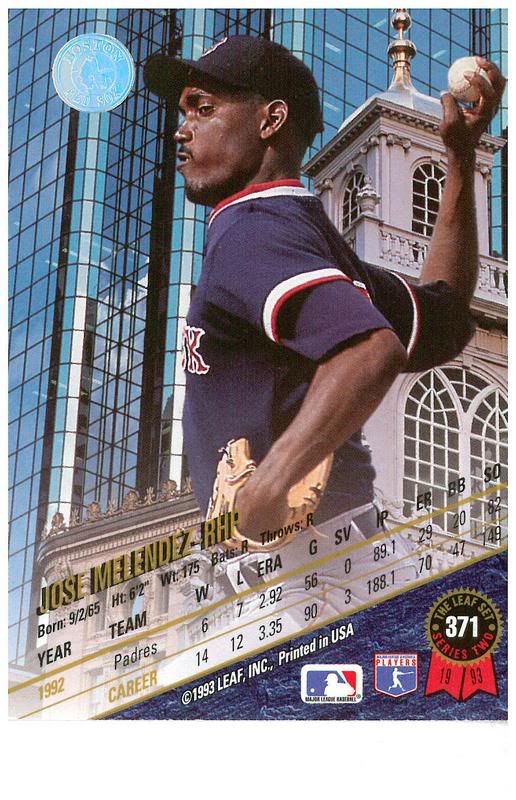
It’s time for Jose Melendez’s KEYS TO THE ALDS.

1. Jose is terrified of tonight’s game. Not a little scared. Not badly frightened.

Terrified.

Jose has never been so terrified by a game in his entire life. Not in 1986, not in 2003, not even in 2004.

Tonight. Tonight is more terrifying.

It’s not that Jose is afraid of losing. Jose knows how to handle a loss… with great bitterness and by taking it out on the people around him.

It’s not that Jose is afraid that a loss means that winter has arrived. Jose lives in the south now; winter never arrives. Not real winter anyway.

It’s not that Jose is afraid that this is the last time he’ll see Jason Bay, Jason Varitek or anyone else named Jason in a Red Sox uniform. There are plenty of other Jasons out there, and all of them except Jason Marquis are better than what’s left of Tek.

No, the reason Jose is terrified is that to survive, the Red Sox are going to have to win three straight elimination games against the Angels, and you know what that means.

Death.

When the Red Sox complete the comeback, history suggests that some poor soul on the Angels is going to die by his own hand.

It’s awful.

Say whatever you want about the Yankees, but they know how to take a bone crushing, soul-destroying defeat, by being contemptible, whiny, but decidedly non-suicidal bitches. Good for them.

But the Angles? When the Angels lose three straight elimination games to the Sox, there’s always a chance that someone is going to take the name “Angels” a little too literally and is going to go for the quick path to the halo.

Jose just hopes that they have a good psychologist on staff.

2. Friday night started with such promise. As Jose drove to Raleigh to watch the game with members of the Triangle Red Sox Nation, he got regular updates on the Yankees collapse from Granny Melendez on the phone direct from Atlanta.

While Granny Melendez doesn’t have the finer points of baseball down and can’t always explain exactly what’s happening on the field, she can convey basic information such as the score and the inning in a pleasant and listenable way. In other words, she is a vastly superior broadcaster to Suzyn Waldman.

So as Jose drove, Granny Melendez informed him that the Twins had crept to a 2-1 lead and then a 3-1 lead. Jose even got her to say “Yankees Suck.” Admittedly, he tricked her.

“How about you give Jose a Yankees suck Granny Melendez?” Jose said.

“Yankees suck?” responded Granny Melendez, not sure that she had heard correctly.

“That’s the spirit, Yankees suck!” chimed in Jose.

“Oh, Granny Melendez, doesn’t like that phrase,” she replied in the third person as is Melendez family tradition. “She prefers Yankees stink.”

“Too late, Jose gets to quote you now.”

“Don’t do that.”

And yet here it is. Jose denied a request from his own grandmother. It’s not Jose’s fault, she should have said it was off the record.

3. No more jokes.
No more puns.
No more scoring zero runs.
When the anthem’s last note sounds
Red Sox need to bat around

No more KEYS to
No more games
No more Sox fans feeling shame
Since we’ve got the wild card
Clay Buchholz is throwing hard

No more losses
Errors too
No much giving up runs to
Angles batters, not at all
Because they can’t take a ball

No more squanders
No more LOBs
No more doing crappy jobs
Of taking bases, driving runs
When something wicked this way comes.

I’m Jose Melendez, and those are my KEYS TO THE ALDS.

Friday, October 9

ALDS Game 2--Incompetence Rewarded

It’s time for Jose Melendez’s KEYS TO THE ALDS.

1. By the time Darren Oliver—freaking Darren Oliver—recorded the last out the bar had changed.

The night had begun as a gathering of grizzled Red Sox fans chugging Yuenglings and chomping on chicken wings cursing C.B. Bucknor, John Lackey and Torii Hunter all the while. But as the night wore on the undergrads flowed in. Young women dressed to the nines, despite being at a bar with sticky floors and sticky palmed frat boys stumbled in in packs like hyenas, cackling incomprehensible. The men in white caps, polo shirts and sweaters joined quickly enough, looking for all the world like everything wrong with America. Entitlement, arrogance, stupid looking caps.

It was, in a way, a metaphor for what had transpired in far away Anaheim that evening. A night had begun with one expectation had ended as something different, something sadder. Just as night with friends became a night surrounded by youth in the full flower of ignorance, a night to celebrate the glory of baseball and the Red Sox in particular had become a night to begrudge, to carp and to complain.

But thankfully, that is not where the metaphor ends. Come two in the morning, the undergrads are gone, and the bar has returned to its lonely natural state with naught but a urine filled trash can as a reminder of what came before. It is the same way with the ALDS. Today is not yesterday, the aggravations of Game 1 are gone, relics of history leaving behind nothing but the urine filled trashcan of a 1-0 deficit. Yesterday was bad; today will be better… It has to be.


2. Among the sub-dramas in last night’s game were the two blown calls by first base umpire C.B. Bucknor.

Bucknor is on the officiating crew for this series, despite being named in a 2006 Sports Illustrated players survey as the worst umpire in the majors, and possibly the universe. At first it might seem counterintuitive to reward massive incompetence with a prestigious job, but Jose would argue that not only is it not unprecedented, it is practically standard practice in this country. Consider the following examples:

• Robert McNamara and Paul Wolfowitz screw up wars royally and get to run the World Bank.
• Grady Little after making one of the dumbest moves in history gets a job managing the Los Angeles Dodgers.
• After staring in Joey, Matt LeBlanc gets a new sitcom.
• Fugitive Roman Polanski wins an Oscar and gets a standing ovation.
• Approximately 10 billion CEO’s who ran their companies into the ground get golden parachutes.
• George W. Bush is reelected in 2004 after screwing up the Iraq war and seeming generally clueless.

Still for every one of these injustices there is a reason that it happened. McNamara and Wolfowitz were being rewarded for loyalty. Little was being rewarded for Frank McCourt being very, very stupid, and basically the front man for his wife. LeBlanc was being rewarded for having once been on a successful show carried by other people. Polanski was being rewarded for Hollywood being full of degenerates. CEOs were being rewarded for being smart enough to rig the game. Bush, of course, was rewarded for hating gays or possibly terrorists.

So the lesson is that people are rewarded for incompetence happens all the time but that there is always a reason for it. The question is what is the reason in the case of one C.B. Bucknor? Jose wonders if his initials, which are not even explained on wikipedia might hold the clue. Jose has come up with a few theories:

1. Cuckolding Bud: For years, Bucknor has been sexually servicing commissioner Bud Selig’s wife, which, unsurprisingly, is the sort of thing Bud digs.

2. Cortland Brotherhood: Bucknor attend SUNY Cortland, and as we all know Cortland’s secret societies run the world.

3. Crack Baby: A crack baby made the decisions on who would umpire playoff games. Literally, an infant born addicted to crack chose Bucknor to be a playoff umpire. This seems like the most sensible option.

4. Coke Bottles: He’s a perfectly good umpire when wearing his Coke bottle glasses, but he doesn’t wear them because they make him look like a nerd. This doesn’t really make any sense, but Jose is a traditionalist and he doesn’t really see how you can mock an umpire without suggesting that he is blind.

5. Crazy Bitches: Man, the people who choose umpires are some crazy bitches.

6. Corns and Bunions: A better umpire was unavailable due to foot problems.


See, there are lots of perfectly reasonable explanations for why the worst umpire in baseball would be rewarded for his poor job performance by umpiring a playoff game. But Jose is going with cuckolding Bud. The only question is whether the commissioner also turns a blind eye to the use of performance enhancing drugs in the bedroom.

3. The big news this morning was that Victor Martinez will indeed catch St. Josh a Beckett in tonight’s critical second game of the ALDS. There had been speculation that Sox manager Tito Eurona might go with the corpse of Jason Vartiek in deference to Beckett’s preference for having base runners steal at every opportunity and having balls sneak by the catcher in critical situations.

The question of course, is whether Beckett will be comfortable with Martinez behind the plate. On the face of it, “Are you comfortable?” is an absurd question to ask in this situation. Maybe it’s appropriate to ask when you’ve invited a friend to take a seat or if you’re a doctor performing a colonoscopy, but to ask a pitcher? It’s kind of weird. Nevertheless, the issue seems to be there, so Jose wants to offer a few things for Beckett to remember if he starts feeling uncomfortable.

• Victor means “one who wins.” Jason means guy who ran all of Greece looking for wool made out of gold—not that bright.
• Heidi Whatney ditched Tek, who left his wife for her, to be with Nick Green. You’ll never see Chris Woodward taking Victor Martinez’ girl.
• The C on Varitek’s jersey does not stand for comfortable. Try to remember that.
• Victor Martinez isn’t great at blocking balls or throwing people out, but he can hit. Jason Vartiek… well, he punched A-Rod in the face once. We all enjoyed that.

So relax Josh. Get comfortable, and remember, it’s not like you’ve never thrown to another catcher in the post season. You threw to Ivan Rodriguez in 2003, and as Jose recalls, that worked out pretty well.

I’m Jose Melendez, and those are my KEYS TO THE ALDS.

Thursday, October 8

ALDS GAME 1--No More Playing the Angles

It’s time for Jose Melendez’s KEYS to the ALDS.

1. Well, this feels kind of familiar doesn’t it?

Jose, who let’s be honest, is aging worse than the bastard child of Curt Euro and Jim Rice, doesn’t have the fastball anymore, so he figured he could rely on trickery to fight his way through the playoffs this year.

The trickery he had in mind was going back to the ALDS KEYS from 2004, 2007 and 2008 to see if there was anything he could just recycle from past ALDS KEYS about the Angels.

No, is the answer. No there is not.

Jose has nothing that he hasn’t regurgitated at least once already. Basically, it’s all about Angles and Normans, Harold and William the Conqueror, and frankly its tired, somnolent even. One can only reference wrestling legend Norman the Lunatic in the context of the Norman invasion of the British Isles so many times (note: once) before it stops being funny or even mildly ironic.

So that’s it. No more. Jose will no longer pretend that the name of the team that our beloved Red Sox are playing this week is the Angles rather than the Angels. Nor will he claim that we are playing the Gleans, the Slag En or any other anagram you can come up with.

No, Jose will actually accept that we are playing a team of creatures that are small enough to dance on the head of a pin and look remarkably like John Travolta circa 1996 or so.

This does raise some serious questions for the series, however. For instance, if a whole bunch of angels can dance on the head of a pin, doesn’t this mean that they will have very small strike zones? How will this affect Dice-K’s ability to throw strikes? Is Michael Napoli the archangel Michael? You know, the warrior guy? Jose is just saying that he doesn’t look so tough.

The challenges run deeper than that though. When Jose thought they were Angles, the key to victory was simple, conquer their island and intermarry with them. But now? Angels don’t live on an island, and as best Jose knows, they don’t marry, so what do we do?

The best Jose can come up with is… bear with Jose… driving a stake through their hearts. Jose is pretty sure he saw a TV show once, Buffy something, where there was a guy named Angel, who Jose figures must be an angel, you know because of his name, who got killed when a blonde chick shoved a stake through his heart.

Jose knows it doesn’t sound quite right, more vampire than angel, but even when this guy Angel got killed or vanquished, which seemed like it happened about a million times, he always seemed to come back a year or so later, just like the Los Anaheim Angels, so Jose thinks he’s on to something.

So Jose says we should go with the stakes, either that or pitching, timely hitting and not playing Tek.

2. In Siren of the Titans Kurt Vonnegut wrote of Angels

There is no reason why good cannot triumph as often as evil. The triumph of anything is a matter of organization. If there are such things as angels, I hope that they are organized along the lines of the Mafia.


It is a fair point. As Jose contemplates the Los Anaheim Angels’ legacy of postseason defeat at the hands of the Red Sox, a string of futility that has seen them win only one of their last 12 postseason meetings, he begins to wonder if Vonnegut isn’t right. Perhaps the Angels’ struggles are a function of organization as much as anything else. Certainly this was the case with the Red Sox in the era that ended in 2004. No matter how gifted the team was it was never well organized. The owner, the rock upon which an organization rests, was always either a drunk, or a racist, or the widow of a drunk or a racist, or the accountant of the widow of a drunk or a racist. And this disorganization flowed downward into managers who were drunks or racists, or who managed like the widow of a drunk or a racist or occasionally were neither drunks nor racists, but did enjoy the burning high of the coca leaf milled powder fine. (Note: Sorry Butch.) The base coaches were probably mostly assholes too, but who can remember?

The results of the disorganization were predictable—failure after failure, loss after loss, heartbreak after heartbreak. But when ownership changed, then management changed (note: after 2003) and then outcomes changed. The Red Sox became the sorts of cold blooded assassins who could let an aging Pedro Martinez walk away or cast DLowe the Paranoid Android into the icy void. And three years later, they won it all again.

But the Angles? The Angles do not appear to be organized like the mafia. For instance, imagine the classic opening scene from The Godfather if Mike Scioscia replaced Vito Corelone.

BONASERA: I -- I went to the police, like a good American... And those two bastards
they smiled at me. Then I said to my wife, "for justice, we must go to Don Scioscia."

MIKE SCIOSCIA (sitting behind his desk, petting a cat): Why did you go to the police? I wouldn’t have gone to the police. What you should have done was first gone to the pawnshop and gotten a pair of brass knuckles for your left hand. Then you should have traded them in for a pair of brass knuckles for your right hand. Then you should have traded those back for a different left-handed pair. Why didn't you come to me first, I could have told you how to do things much better than you did them.

BONASERA: What do you want of me? Tell me anything. But do what I beg you to do.

MIKE SCIOSCIA: What is that?

[Bonasera gets up to whisper his request into Don Scioscia’s ear]

That I cannot do. But I have a better way to do it. It doesn’t involve so much… force… but it involves a lot of running. Running this way, then the other way. Maybe some hit and running even.

BONASERA: I'll give you anything you ask.

MIKE SCIOSCIA: We've known each other many years, but this is the first time you came to me for counsel, for help, for assistance, for advice, for ideas…But let's be frank here: you never wanted my friendship. And uh, you were afraid to be in my debt. And that’s really too bad because I have a lot of really good ideas. I’m incredibly smart. Smarter than you. So smart that I won the 2002 World Series.

BONASERA: I didn't want to get into trouble.

MIKE SCIOSCIA: I understand. That’s why I like the hit and run. Keeps you out of double plays… or sometimes it gets you into double plays, which I like to call double trouble. But uh, now you come to me and you say -- "Don Scioscia give me justice." -- But you don't ask with respect. You don't offer friendship. You don't even think to call me Manager. Instead, you come into my house on the day of ALDS game 1, and you uh ask me to do murder, for money.

BONASERA: I ask you for justice.

MIKE SCIOSCIA: Technically, that is not justice; your daughter is still alive. Also do you really want David Justice, he only stole 53 bases in his entire career? That’s pathetic, stolen bases are so important.

BONASERA: Then they can suffer then, as she suffers. How much shall I pay you?

MIKE SCIOSCIA (stands, turning his back toward Bonasera): Bonasera... Bonasera... What have I ever done to make you treat me so disrespectfully?

BONASERA: Be my friend -- (then, after bowing and the Don shrugs) -- Manager?

MIKE SCIOSCIA (after Bonasera kisses his hand): Good. Some day, and that day may never come, but it probably will. I'll call upon you to do a service for me. But uh,
until that day -- accept this justice as a gift on the day of the ALDS Game 1.

BONASERA (as he leaves the room): Grazie, Manager.

MIKE SCIOSCIA: Prego.
(then, to Tom Hagen, after Bonasera leaves the room)

Ah, give this to ah, Clemenza. I want reliable people. But then if he doesn’t get it done give it to Tessio, but if Tessio doesn’t look so good, go out and visit him, and then if he still doesn’t look so good visit him again and then take him off the and give it to Luca Brasi. And make sure they bring a baseball bat, but I don’t want them to swing the bat… too risky. Instead have them play it safe and just sort of tap these guys with bat, softly. Maybe our guy will get arrested, but it will be a productive arrest. I just want to make sure that we run a mafia the right way. Like the old time mafia. You know, maybe I’ll go and supervise, offer some pointers. Could David Eckstein do the job?


You can begin to see the contours of the problem now can’t you? This sort of organizational structure is too top down and too micromanaged to successfully rough up anybody, much less run rackets.

The flip side, of course, is that if Don Corleone or any other really top flight Mafiosi had been managing the angels for the last five years, the Angels would have absolutely beaten the Red Sox after Manny Ramirez freaked out when he found the carburetor from his prized Cadillac in his bed.

3. In his column yesterday in the Orange County Register, Bill Plunkett asked a provocative question: “Are the Red Sox inside the Angels’ heads?” At first it seems stupid, idiotic really. How could an entire baseball team fit inside a man’s head? But then you realize that it’s a metaphor and you always take things way too literally after 12 beers.

Which leaves the question, well it leaves the question the next morning anyway: Are the Red Sox figuratively inside the Angels heads?

And the answer is yes. Yes they are. After perusing the DSM-IV, Jose has concluded that the Angels collectively are suffering from hydrophobia. Wait, never mind, that’s rabies. The Angels don’t have rabies, that’s the Yankees, well Joba anyway, drooling idiot.

What the Angels have is aquaphobia, a fear of water—dirty water in particular.

I’m Jose Melendez, and those are my KEYS TO THE ALDS.

Wednesday, September 2

Just Like Roosevelt

It’s time for Jose Melendez’s KEYS TO THE GAME.

1. Jonathan Papelbon picked up a six out save last night.

Think about that. Jonathan Papelbon picked up a six out save last night. Dick Radatz got six out saves, but Jonathan Papelbon? Not so much. If it didn’t stretch the limits of his endurance, it was only a 28-pitch outing, it at least pushed the limits of tradition. In fact, the precedents for such a brazen rejection of traditional boundaries are limited. Jose has done a little research and come up with the following comparables:
• 1940, President Franklin D. Roosevelt seeks, and wins an unprecedented third term as President.
• 1996 Jasmin St. Claire, rather than stopping at having sex with a virginal 250 men in a day, goes all the way to 300.
• 2001 Takeru Kobayashi does not stop after breaking the world hot dog eating record of 25 in 12 minutes, but continues to eat until he has doubled the 12-minute record.

What all of these feats have in common is that they required competitors to push themselves a little harder than normal, to take some risks in order to master the task at hand. Jose has no doubt then when Ms. St. Claire pursued the sex record, many of you were screaming “Get her out of there Tito, let Daniel Bard finish this one off” but sometimes that’s not how it works. Sometimes a champion just has to… extend… him or herself to do what needs to be done, and last night Jonathan Papelbon did just that.

The exception, of course, is the 2003 ALCS, when Grady Little asked Pedro to do more than was possible, infuriating sox fans and online sports bettors alike. That was like asking FDR to run for a fifth term post mortem, insisting that Jasmin St. Clair go for 500 or insisting that Kobayashi should replicate his feat with foot long dogs.

There’s good crazy (note: the kind that leads to slashing prices) and bad crazy (the kind that leads to slashing wrists) and it’s not always clear until after the fact what kind of crazy one is looking at.

2. Jose is much angrier in America then he is in Africa. Jose won’t say that he is happier at home, per se, just less angry. In Uganda, if there is electricity in the wires, water in the pipes and no parasites in the intestines, it’s going to be a good day. But almost as soon as Jose got off the plane in Boston a few weeks ago, his ability to take solace in the flow of electrons dissipated. Here, you see, we have baseball. And baseball, it turns out, makes Jose an angry man.

Leigh Montville, as Jose recalls, once wrote that every day he looked at the front page of the paper to makes sure we weren’t at war and then went to the sports. Jose has a similar philosophy. Every day, Jose looks at the front page, discovers that we are at war, twice, gets angry, and then goes to the sports section, where if the Red Sox have lost, he gets really angry. If they’ve won, his mood is moderated, maybe he’s even happy, but if they’re lost… look out. Angry, angry, angry.

Sometimes Jose will even get angry about being angry, but that’s a negative feedback loop, bad things leading to bad things, which lead to more bad things. It’s kind of like a Nick Green at bat.

This is where Jose should preach about how in living in a poor country made him see things differently and not only appreciate the little things, but reject foolish passions like sports and celebrity. But here’s the thing: It didn’t. If anything it made him appreciate the need for escapism, the need to, from time to time, substitute the emotions of others for one’s own. Do you think that the villagers in Uganda are any less in need of escapism then we are? In Uganda, people pay what little money they have to sit on hard wooden benches in a sticky, airless room and watch a soccer match. Do you think even Red Sox fans would do that for a ballgame? Well, yes, they do it at Fenway 81 times a year, but do you think they’d do it to watch the game on TV? Well, not the pink hats anyway.

The point is that people, all people, want escapism. We want to live vicariously at least some of the time. All of the accoutrement of the modern sports fan, the fantasy sports the online betting, they are but catalysts, enzymes of the mind designed to accelerated and intensify the vicarious thrill. But to live vicariously is to live dangerously, to cede control of a tiny portion of one’s personal sovereignty to something over which one has no control. Jose may not have much control over the electricity in Uganda, but at least Jose can juice up while the power is on; Jose can prepare for darker days ahead. But as a Red Sox fan, Jose has no choice but to live with the consequences of the actions of others. And this powerlessness, is infuriating; it is intoxicating.

It is what makes Jose love being a Red Sox fan, and it is what makes him angry. But it is a good kind of anger, a pleasantly impotent rage, a substitute for staring at the madness of this world, at Darfur, Burma or Afghanistan and going daft from the righteous anger raised by man’s inhumanity to man. It does not deaden Jose’s concern, but it does deaden his pain, and enables him to think rationally about the needs and the horrors of the world. Jose gets angry at the Red Sox so he can think clearly about the war, so that anger, an irrational emotion, spends its time directed towards an irrational game while the logical focuses on all the trouble in the world.

3. Congratulations to Jon Lester, who last night set the Red Sox record for strikeouts by a lefty in a single season. While setting any record for a baseball franchise that has existed for more than 100 years is impressive, this one is special. Setting a left handed pitching record on a team that has had, among its stars, a pitcher actually named “Lefty” is extraordinary. Really, they don’t call someone “Lefty” because he’s only okay with his left hand.

Think about it this way. Jacoby Ellsbury setting the Red Sox single season steal record was impressive, but it would have been so much more impressive if Tommy Harper had been nicknamed “Two Legs” Harper. (Note: As Jose recalls, Ellis Burks’ nickname should have been “Three Legs” Burks.) Or what if David Ortiz had taken the single season home run record from a man named “Gigantic Freaking Biceps” Foxx. Hell imagine if Julio Yugo had set an errors record by beating out Edgar “Girlie Arm” Renteria. Yes, Jose knows that the previous record did not belong to Lefty Grove, but the argument still holds. If you set a record at anything and beat out a guy who is named for the critical body part in the record setting act, you’ve done something pretty special.

I’m Jose Melendez, and those are my KEYS TO THE GAME.

Saturday, August 22

Of Skulls and Human Weakness

In Rwanda, they count lives in skulls. Each chalky gray orb is a person, a Yorick to some Hamlet who, alas, knew him.

They count lives in femurs too, at a rate of one to two. Each pair is a man, woman or child who used to kick a football, walk to school or run from danger

Each pelvis is a life as well, a person who danced, made love or bore children. The bones, the scaffolding that supports tired flesh, are all that remain of 800,000 people. The hearts that pumped blood, that kept the steady rhythm of life, are gone. The brains that mastered algebra or planned the harvest are gone. All that remains are the piles of bones—in memorials, in mass graves, in farmers’ fields. Like the fossils of dinosaurs, they are reminders of life driven from this good Earth, scientific proof that something ghastly transpired.

The power of the memorials to the victims of the Rwanda genocide is that, save for the genocide museum in Kigali, they are not museums or monuments—they are crime scenes. When I visited Auschwitz on a sunny July day, it was possible, to mistake the death camp for the military barracks it once was. Even the crematoria, if one did not know what they had once been used for, could have seemed innocent. Only the careful collection of eyeglasses and hair and the films of starving Jewish victims crammed into the barracks showed the grim reality of the place.

This is not the case in Rwanda. The sites of massacres look like there were massacres there. In Nyamata, a tidy town 35km from Kigali, there is a church where genocidaires murdered 10,000 people. One knows this not because of archival footage, photographs, documentation or even survivor testimony, but because the victims are there. Their skulls, their bones are neatly sorted and laid on musty shelves in the catacombs beneath the church. In the sanctuary, tattered, blood splattered clothes carpet the floor, proof that these are not the bones of people who died, but of people who were murdered, regular people who had sought sanctuary in a church.

Above it all stands a statute of the Virgin Mary, right where she was when she witnessed the massacre. Her mouth cannot scream, her eyes cannot cry but surely, if she is the mother of God, her heart must be bleeding,

A few kilometers back toward Kigali, the village of Ntarama, another crime scene, tells the same story. The Hutu genocidaires threw a grenade into the local church before coming in with the machetes and slaughtering 5,000 souls. In an annex to the church, the wall is still stained with the blood of a baby thrown against by a genocidaire who treated him like a sickly chick to be culled.

I had had enough. As I drove through the countryside, everywhere white banners with purple writing noted a genocide memorial, but I did not want to visit them. Neither macabre curiosity nor my sense of obligation to the victims could compel me. I did not need to visit the school where not only the skulls, but the bodies of victims remain, mummified by lime, as the ultimate evidence of the crime.

If one travels through Rwanda today without knowledge of its grim history and oblivious to the signs marking genocide memorials, it would be shocking to learn that the country had been the site of one of history’s greatest crimes. Of the 15 African countries I have visited a list that includes continental powerhouses South Africa and Egypt, Rwanda is by far the most orderly. Rwanda’s main roads are neatly paved and traffic laws are widely observed. Even in the provinces, motorcycle taxis will only take one passenger and both driver and passenger always wear helmets, as is required by law. Even stranger, the Toyota minibus taxis, ubiquitous throughout sub-Saharan Africa adhere strictly to the law that they may not carry more than 18 passengers. Elsewhere in Africa, if such laws exist, they police enforce them only to the extent that they are useful in gathering bribes. In Uganda, for example, squeezing 25 people into a minibus is common.

Rwanda’s obsession with order extends beyond traffic to environmentalism. In a highly publicized move, Rwanda banned plastic bags, a major source of litter in Africa, going so far as to inspect visitors at the border for the polyurethane contraband.

Paul Kagame’s Republic even has mandatory community service. On the last Saturday of every month, all business in the country screeches to a halt from eight to 11 in the morning for Umuganda. Even public transportation stops as the Rwandans pour into the streets to clean up their communities.

The combined result of these and other state policies is a country that is safe, clean and remarkably orderly, in the heart of a continent where disorder, if not chaos, is the norm. So how did orderly Rwanda, of all places in Africa, become a place where lives are counted in skulls? I do not know what Rwanda was like before the genocide, but President Paul Kagame’s success in imposing law on his country in a continent where law is as often as not, nothing more than a tool for extortion, makes me wonder if there is something in the Rwandan culture, that imbues its people with a profound respect for authority. Perhaps this respect for authority can serve the good, as people obey the law, but also the bad, as the same people unquestioningly obey the mad orders of a genocidal state?

As a counterfactual, I considered the example of Uganda. Uganda had its own near genocides, Idi Amin took 300,000 lives and Milton Obote another 100,000, but in both cases, the character of the killings was fundamentally different from the Rwandan genocide. In Uganda, the massacres were exercises of military power—ascendant ethnic groups used military might to exterminate their enemies. Civilians were not a major element of the death squads. In Rwanda, by contrast, much of Hutu society was mobilized in the killings. It was as much a civilian genocide as a military operation.
Perhaps it is not a coincidence that Rwanda and Germany, two countries where deference to authority is, or at least was, built into the national character are the settings for two genocides?

I asked Ignatius, my Muganda friend and traveling companion, if he could imagine a genocide on that model happening in Uganda.

“I do not think so,” he said. “Even if people hated the other tribes enough, which is possible, I do not think the Ugandan civilian population could be organized enough to do something like this. Maybe some people would participate, but most, would not. Even, I think, some who would want to kill would not have the organization to do what they planned. They would not manage to show up.”

In a way, it is a sick joke. The lateness, the disdain for authority, and the culture of bending rules that sometimes makes Uganda an infuriating place to live, may also provide a sort of protection against the worst possible outcome. A government that cannot make the trains run on time, may also struggle to make the death squads run on time. But in Rwanda, a country whose organization evokes the West, they have duplicated the greatest sins of Western civilization. Not only can they pave roads like us, they can kill like us.

But this is just a theory, the desperate attempts of one observer to explain what he cannot possibly understand. I want to understand the genocide, to grasp its intellectual foundations because then I can explain it away; I can explain how a unique set of historical and social circumstances turned average people into killers and their country into a slaughterhouse. But I’m not sure that is possible. A people may be more or less violent, a country more or less chaotic, but those are contributing factors, not the fundamental explanation of the Rwandan genocide or any of the great historical crimes. The underlying explanation, I suspect is that the human animal, despite the moral sense that compels him to do good, is fundamentally weak. The Rwandans, the Germans, all of us, are engaged in a constant struggle against our demons, both personal and historical, against the forces that would turn farmers into killers, and other farmers into piles of bones. What happens in a place like Rwanda or Germany is that the structure we have established to fight our weakness, the rule of law and the rule of conscience are inverted as the state and moral institutions like the church go from being the opponents of human weakness to its exploiters.

It is not a coincidence, that there is no genocide where there is anarchy. Surely there is murder in anarchic societies, perhaps murder on an unimaginable scale, as in Congo, but genocide takes organization, and genocide demands the application of power. Human weakness alone is enough to unleash the horrors of war and murder, but a genocide cannot run on weakness alone, it is the weakness of the individual amplified by the strength of numbers.

The genocide, all genocides are not a violation of a human nature, an exception to the laws of man and God, they are a manipulation of those laws, an always lurking byproduct of civilization.

In Rwanda, as in Germany and Turkey before it, the weakness became powerful, murder became the law, and so they count lives in skulls, and deaths in hundreds of thousands, and still can we really say “Never again” and mean it?

Monday, August 17

Why Goma is Crazy: From Diseased the Right Ventricle of the Heart of Darkness

Goma is crazy. The fact that a Congolese man showed me his penis, however, is not what makes Goma crazy.

In most other cities, a Congolese guy shouting what presumably translates as “Hey white man, look at this,” while yanking down his pants on a busy market street at two in the afternoon would be the yardstick by which all madness was measured. Schizophrenics would look on and say, “Well, I have issues, but I’m not as crazy as him.” In Goma, however, it barely prompted a glance from onlookers of all ages.

I was annoyed and maybe a little horrified, bellowing a guttural “NOOOOOO!!!” to show my disapproval. Ignatius, my Ugandan fellow traveler was more philosophical, stoically remarking “He must be proud of how bushy it is.”

The flasher does not define Goma’s lunacy because the Congolese town, bordered by Lake Kivu and Gisenyi, Rwanda, is a harmonic convergence of crazy and awful. It starts with the combination of lava, gorillas and guerillas and pretty much spirals from there. If Conrad was right that Congo is the heart of darkness, then Goma is its diseased right ventricle a chamber of the heart simultaneously battling heartworm, a murmur and at least three blockages.

The crazy began at the border as Rwanda’s well ordered, if secretly seething society, gave way to Congo’s poorly ordered and openly seething one. As soon as we officially entered the country, a Congolese gentleman who may or may not work for the government expressed grave concern over Ignatius’ absent yellow fever immunization card. Thankfully it turns out that the mere act of giving money to a Congolese gentleman who may or may not work for the government provides immunity against yellow fever.

“Mzungu has card, ok. But Uganda has no card… problem,” the official explained in a mix of broken English and French.

“But surely sir there must be some fine we could pay,” I said using the international standard for “May I offer you a bribe?”

“Twenty, twenty,” the man responded.

“But sir, I do not have 20, I have only 10 dollars,” I countered.

“I was meaning 10, not twenty,” the official replied, and just like that Alexander Hamilton negotiated the Congo border far more effectively than he managed Aaron Burr.

While I was proud that, for the first time in my exhaustive travels I had managed to pay a bribe rather than having a local fixer handle it for me, I did not regard this as particularly crazy. It was annoying, but it was utterly predictable.

What was crazy, however, was the obsessive-compulsive meticulousness of the immigration official who managed the formal migration process before we had even needed to issue a bribe. The matronly woman in the calico dress who handled our visa issues did not ask for any money beyond the official visa fees. That was not her modus operandi. To her, the key to controlling the cross border raids into Rwanda, the smuggling of goods and perhaps even the war itself was to draw perfectly straight lines on the book of graph paper that served as the immigration register.

We had the poor fortune to be the first visitors to Congo on a new page of the register. This meant that the matron needed to go through the lengthy process of creating columns on the new page that exactly matched those on the old page. After checking the old page she would jot a little hash mark on the new page before flipping the book back for the next chart.

Flip. Ten squares for name on the old page.

Flip. Count ten squares on the new page. Make a mark.

Flip. Two squares for gender on the old page.

Flip. Count two squares on the new page. Make a mark.

Only when she had flipped the page some 14 times to cover seven columns, did she finally take a brand new, clear plastic ruler from its polyurethane packaging and draw crisp lines formally marking each column. This was all well and good until a line went a bit crooked, then out came the whiteout. If you have ever wondered how the whiteout industry stays in business in the computer age, the answer is to be found in the Congo. There is no error so tiny that it is not worth applying a dab of liquid paper. Yes, it seemed that the fragile Congolese peace was dependent almost entirely on the ability of this border official to draw perfect lines.

The second indicator of craziness is that the streets are made out of lava.

That’s right the streets are made out of freaking lava.

Okay, okay, it is not the red molten stuff of nightmares and Ben Affleck movies, but the streams of porous black are a sufficient reminder, frozen in time, of the destruction that came before and could just as easily come again. In 2002, Mount Nyiragongo erupted creating what the few tour books that amazingly still include Goma refer to as an “African” or “modern” Pompeii.

I disagree. I have been to Pompeii; I have seen the ghostly, ashen figures vaporized, their faces contorted by fear, forever crying out with their dying breath. In Goma, the fear is also present but not in Pompeii’s petrified form. In Goma, the fear is alive. It moves, evolves changes, but never goes away. The fear is the constant. Today it may be fear of an eruption, tomorrow fear of the guerillas lurking in the mountains and the day after the fear of starvation, but it is always fear.

The people of Pompeii had it easy. Even if for week they watched the mountain threaten destruction, their darkest instant, their time to contemplate imminent extinction lasted for one horrible moment, before the very stuff of the Earth claimed them. The people of Goma must contemplate extinction for all horrible moments.

But the lava at least creates as it destroys. As it leveled homes and business, the lava spit new land into Lake Kivu. The black lumps of igneous rock that represent disaster in the old town present opportunity on the lakeshore. They also represent a new kind of crazy—separation of rich from poor through the sifting of trauma. In the old town, the poor, the old Gomans, those not savvy enough or ruthless enough to grow rich from the war live in a labyrinth of tattered shacks. The more fortunate among them enjoy the meager security of a corrugated iron roof and walls held together with cement rather than hope.

On the new land, the construction is grandiose. Everywhere, the trash-strewn streams of hardened lava are framed by gaudy new mansions. Tidy green lawns right out of suburban America front columned monstrosities right out of Lagos’ ritziest neighborhoods. Grotesque decadence and grotesque deprivation cohabitate in a fashion that even the elites of Rio or Johannesburg would regard as depraved. The question unanswered is who owns these houses?

The question is unanswered because it is unasked. Approaching any gate at any house seems like an exercise in futility at best or suicide at worst. Not only are the houses wrapped in menacing walls trimmed with razor wire, they are guarded by men with guns. They are not even earthbound men with guns. Instead, they sit high in fortified turrets behind the compound walls, watching eagerly for a threat or an excuse. While I imagine that the houses are built by Congolese warlords, ex pats who wish to live like proconsuls or both, I will not risk my life to ask.

And then there are the clashing go/guerillas. High on the volcano live a handful of the earth’s few remaining mountain gorillas. On the same mountains, lurk troops of Congo’s far to numerous mountain guerillas.

The competing homonyms dance along the mountainside, circling the crater’s lava lake as if they are playing some grand and terrible game of ring around the rosy where inevitably, we will all turn to ashes and fall down. The gorillas serene and gentle beckon visitors for naught but the high price $425. The guerillas, silent and deadly, warn tourist away by threatening to exact a far higher price. And on and on it goes, as a lake of lava somehow become this least frightening thing on a volcano.

And so it goes in Goma. Violence begets violence; madness begets madness and penises beget amusing anecdotes. “Goma is crazy!” I can now declare with authority.

And I am right, Goma is crazy, but it no longer seems amusing. As I left Goma, Secretary of State Hilary Clinton was arriving to address the ongoing conflict in the region and the fallout. Among the issues she addressed most forcefully was the epidemic of rape in the hills, villages and refugee camps surrounding Goma.

I knew about the war, about the slaughter that began with the Rwandan genocide and still continues, but this aspect, the use of rape as a weapon and the tens if not hundreds of thousands of victims in the Kivu region alone had, perhaps willfully, escaped my notice. I wanted to go to Goma to see what it was like, to see up close how a war zone smells, and perhaps to revel in my own bravery and adventurousness, to applaud myself for stabbing into the heart of darkness like Conrad and Stanley before him. But I am not Conrad or Stanley. I am not even a Ben Affleck. The terrible actor whom I mocked above toured Goma in 2008 to raise awareness of the rape epidemic there. When one has failed in a comparison to Ben Affleck, it is time for some introspection.

It is adventurous for me to have gone to Goma, I suppose, but it is also narcissistic and pathetic in a way. On any different day for a different person, for a Congolese person, my story ends differently. It still begins with a man exposing himself, but he is not this man I saw, or maybe he is? He is drunk or mad, perhaps turned feral by war, and after it begins with this man exposing himself it does not end with a trip across the border to Rwanda, a cold beer at a hotel and a lifetime memory of how crazy Goma is. It ends instead in a life ruined. It ends with the horror. It ends with the darkness.

Goma is crazy. But I should not delude myself about what crazy means. Goma is not eccentric or quirky, a Van Gogh severing his ear to prove his love. Goma is psychotic. Goma is pathological. It is Jack the Ripper stalking the streets of London for someone to dissect or Stalin imposing his paranoia on a nation. Goma is not just crazy, it is criminally insane, and even in this age of wonders, of Prozac and plutonium of antipsychotics and antipersonnel mines, of lithium and largesse, we have no idea how to cure that kind of insanity.

Saturday, August 8

Back on the Active Roster

It’s time for Jose Melendez’s KEYS TO THE GAME.


1. There is an old and prophetic saying in Uganda, in much of the Great Lakes region of Africa really, that is worth recalling in this, our darkest hour. Well, a dark hour anyway

“I will beat you.”

It is not a threat per se; it is a guarantee. It is an expression of certainty that the future is written.

What does a teacher say to a misbehaving student?

“I will beat you.”

What does a husband say to the man he has caught in bed with his wife?

“I will beat you.”

What does a humble social worker say to the family of a neighbor who has stolen from him as soon as he is absolutely certain that the thief, who might fight back, is nowhere in sight?


“I will beat you.” Well, not the family, the guy.

And what do the Red Sox say to the Yankees?

For eight games this season, it was “I will beat you,” but now for three games, who knows what they are saying?

“You can beat us now?”

“Please sirs, we can’t bear another thrashing?”

“I might beat you?”

“I will attempt to beat you?”

Whatever they are saying, it is not working.

Allow Jose to illustrate. Consider the story of a man who is sleeping with another man’s wife in the marital bed. The cuckolded husband returns unexpectedly to discover the indiscretion, and what does he do? Does he allow the fight to go on for hours without anyone scoring a blow? Does he concede defeat to a giant fat adulterer attempting to look skinny by wearing pinstripes? No, he declares simply, in cold and righteous anger, “I will beat you.” And then he does.

It is that simple. It is that brutal.

I will beat you.

I will beat you.

2. Among the difficulties of traveling to distant lands during the baseball season is getting the news of the day in the form of news of the month. For instance, Jose completely missed the Adam LaRoche era. Jose learned that the Red Sox had both acquired and dealt LaRoche at pretty much the same time. In a way, it’s like getting asked out on a first date and told there will not be a second at the simultaneously.

In the normal dating process, a couple (note: or more if you roll that way) starts by agreeing to go out on a date. Then each person gets nervous and maybe even a little giddy with anticipation. Each thinks about what to say, what to wear and where things might go. They have dinner or a drink perhaps take in a film and chat about whatever interests them. Then at the end of the evening, or perhaps even a few days after, they make independent decisions about whether the date was good enough to repeat. If both agree, then they proceed towards a future of some kind, but if even one rejects the premise of a second date, that’s all there is. You know, unless one of them is all stalkery.

But in the case of Adam LaRoche, for Jose it was like a date where a lady tells him even before the first sip of wine or bite of food, hell, as soon as the date is set, that it isn’t going to work. There’s no anticipation, no pleasant tingle, not even the chance for the exhilaration of success or the heartbreak of rejection. And what’s the fun of that? Oh that’s right, Jose didn’t have to watch Adam LaRoche take at bats for a team that is allegedly trying to contend. Very good.


3. Goma, Congo is a mad city. The streets are petrified rivers of lava, the houses are shanties of mud and tin and gorillas and guerillas dance cautiously on the side of a volcano. All of them, ape and man, terrorist and soldier, corrupt border guard and… other corrupt border guard live in fear that one day, one day soon, the conflicts and trials of life may be made irrelevant by a rain of molten rock.

Yet in this most hopeless of places, one man knows hope. Amidst the dust and debris, the chaos and the corruption, Jose saw a man brandishing a symbol of hope, a sign of all that is great and good. It was not a cross, begging the Lord for mercy, the Cross has done the Congolese little good. Nor was it the pale blue of the nations that are hardly united. Rather, it was a tattered blue T-shirt with the number 45 etched in fading red. Martinez, it read on the back. Martinez.

In this sad and struggling land, there was a reminder of something good, something decent in the world. Yes, there was a nice hospital and some good social programs, but damn it, this was a Pedro Martinez shirt, a symbol of all that was once good and can be again. And right then, just after he learned that $10 when given to a border guard can inoculate against yellow fever without an injection and just before a Congolese man decided to show Jose his penis, that shirt gave Jose just a little bit of hope for the Congo.

On the other hand, the Edgar Renteria Red Sox shirt Jose saw in Uganda signaled that the land of the crested crane is pretty much doomed.

I’m Jose Melendez, and those are my KEYS TO THE GAME.